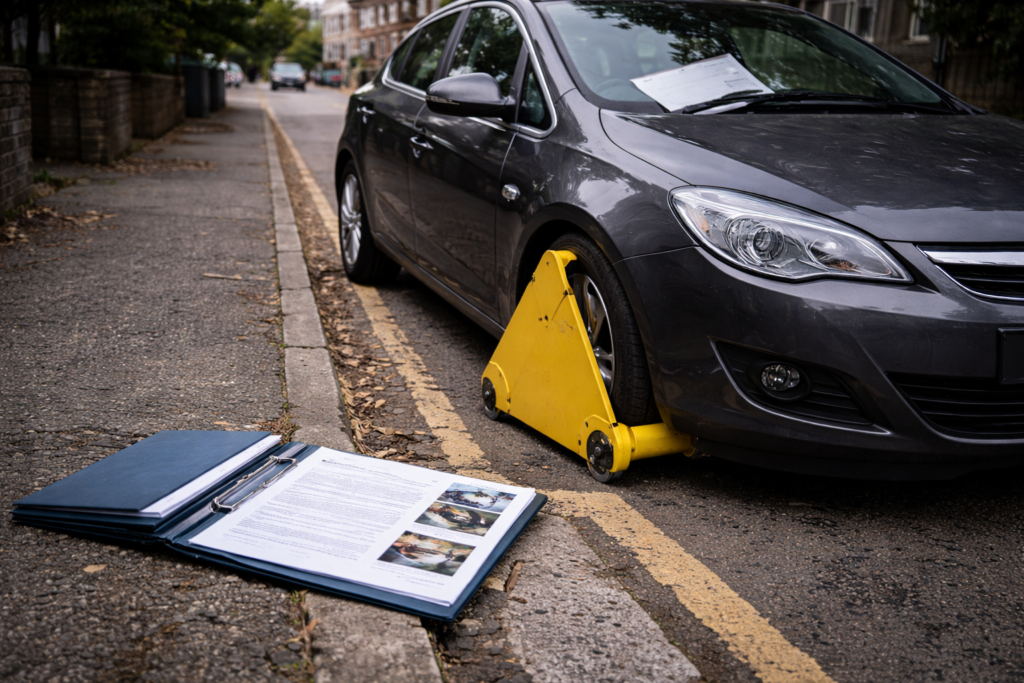
Send a written “cease enforcement while appeal is pending” notice to the parking operator today, and include proof the appeal is open and the clamp is preventing use of the vehicle. If nothing is done, the clamp often stays on and extra charges are added while the operator treats the case as unpaid. Ask for the clamp to be removed immediately and for all fees to be frozen until the appeal decision is issued. If the operator refuses, move straight to the official complaints route and prepare to escalate using the operator’s own process and the relevant trade body route where applicable.
Keep everything in writing and focus on practical outcomes: removal of the clamp, confirmation the account is on hold, and a clear decision date for the appeal. Avoid arguments about fairness at this stage and stick to evidence and process.
What the problem is
This usually comes up in UK private parking situations on retail parks, residential developments, hospital sites, or managed business estates where a parking operator is contracted to control bays. The driver or keeper has already lodged an appeal through the operator’s portal or by email, received an acknowledgement, and is waiting for a decision, but enforcement continues anyway. The clamp is then applied on-site by a contractor or attendant, sometimes with a demand for immediate payment before release.
It tends to appear after a partial response such as “appeal received” or “under review”, or after a delay where the operator has not issued a decision within the timeframe stated in its own correspondence. It can also happen after a change of operator, where the appeal is sitting with one system and enforcement is being carried out by another team. The immediate impact is practical rather than legalistic: the vehicle cannot be used, work and family commitments are disrupted, and the operator gains leverage by creating urgency.
Why this happens
Most cases come down to process gaps and incentives. Appeals are often handled centrally, while enforcement is carried out locally, and the “hold” flag is not applied correctly to the vehicle registration or charge reference. Some operators treat an appeal as a separate track from enforcement unless a specific “enforcement pause” request is logged, so the clamp team continues working from a live list of vehicles or unpaid notices.
Another common driver is payment pressure: clamping creates a strong incentive to pay first and argue later, especially when release fees are presented as time-sensitive. Where sites have multiple rules (permit schemes, visitor registrations, loading allowances), enforcement staff may act on a snapshot view and not see that an appeal is pending or that evidence has already been submitted.
A typical organisational response pattern is that the first reply is a template message asking for the same details again, while the enforcement side continues unless a manager intervenes.
Your rights or position
In practical UK terms, the strongest leverage is to keep the dispute framed as a process failure: an appeal is open, the operator has acknowledged it, and enforcement should be paused until a decision is issued. Operators are more likely to act quickly when the request is narrow and verifiable: remove the clamp, confirm the case is on hold, and provide a date for the appeal outcome.
It also helps to separate two issues: the underlying parking charge and the immediate immobilisation. Even where the operator believes the charge is valid, continuing enforcement during an active appeal is difficult to justify operationally and creates reputational risk for the landholder or managing agent. A calm, evidence-led complaint to the operator and, where relevant, the site management often produces faster action than debating signage or mitigation at the same time.
Where payment is being demanded for release, the practical position is to avoid making admissions. If payment becomes the only way to regain use of the vehicle, the aim is to pay in a way that preserves the dispute (for example, clearly stating it is paid under protest in writing immediately after) and to keep a complete record for later challenge through the operator’s process.
Legal or official basis
For private land in England and Wales, clamping by private parking operators is generally prohibited, and disputes about immobilisation often turn on whether the clamp was applied lawfully and by whom. In practice, raising this point works best when it is tied to a clear request: immediate removal and written confirmation that enforcement is paused while the appeal is decided. The official reference most people use to support that practical request is the government’s overview of private parking enforcement and related rules, which helps keep the conversation grounded in what is expected of operators rather than personal opinion.
What evidence matters
Evidence that the appeal is genuinely in progress is what usually shifts the operator from “pay to release” to “hold and review”. Collect items that show dates, references, and the operator’s acknowledgement, plus proof of what happened at the vehicle. Keep the evidence focused: it should allow someone senior to see, in minutes, that enforcement continued despite an open appeal.
Also collect context that explains why the clamp is disputed without turning it into a long narrative. For example, if the appeal is about a permit system failure, capture the permit, the resident/visitor authorisation, and the instructions given by the site. If it is about a machine or app issue, capture the error screen and the attempt to pay.
Key records
Save screenshots of the appeal submission page, the acknowledgement email, and any portal status showing “open” or “under review”. Photograph the clamp on the wheel, the warning notice attached to the vehicle, and the nearest signage that sets out enforcement terms. Keep a timeline of contacts with dates and times, including any phone calls and who was spoken to.
Things to avoid
Do not remove or tamper with the clamp, even if it seems straightforward, because that can create a separate dispute about damage or interference. Do not rely on verbal assurances from on-site staff without written confirmation from the operator. Do not send original documents; send copies or clear photos.
Quick checklist
- Appeal acknowledgement and reference number
- Photos of clamp, notices, and nearby signs
- Proof of permission to park or attempted payment
- Record of all contact attempts and responses
Common mistakes
Three common mistakes are paying without immediately confirming in writing that the appeal remains open, sending a long emotional message that buries the key facts, and missing the operator’s stated complaint route while arguing only with the on-site attendant.
One thing not to do yet is to post allegations on social media before the operator has had a chance to remove the clamp and confirm the case is on hold, because it can harden positions and slow down practical resolution.
What to do next
Send hold request
Use the operator’s official appeals or complaints channel only (their portal or the email address shown on the notice) and send a short message headed “Appeal pending — request immediate clamp removal and enforcement hold”. Attach the appeal acknowledgement, the clamp photos, and a one-paragraph timeline. Ask for three specific confirmations: the clamp will be removed, the account is placed on hold, and the appeal decision date.
Contact site manager
If the location has a managing agent, retail park management, housing association office, or facilities team, send the same evidence bundle and ask them to instruct their contractor to pause enforcement. This often works when the operator is slow to respond, because the landholder can prioritise removal to avoid disruption on-site.
Paying under protest
If the operator refuses to remove the clamp unless a fee is paid and the vehicle is needed urgently, keep the payment trail clean. Pay only through the operator’s stated method, keep the receipt, and immediately send a written note that the payment was made under protest while an appeal is pending and that a refund is expected if the appeal succeeds. Do not agree to close the appeal as a condition of release.
Escalate properly
If there is no meaningful response, escalate using the operator’s official complaints process and ask for a supervisor review, not another template reply. Where the operator’s behaviour suggests poor control of enforcement during disputes, it can also help to check whether the business structure has changed or been wound down; patterns like this are covered in Company dissolved during dispute, which becomes relevant if emails start bouncing or the operator claims the matter sits with a different entity.
Expected timelines
For urgent immobilisation issues, a same-day or next-day operational response is the normal expectation once the right team sees the evidence, even if the appeal decision itself takes longer. If there is no response within 48 hours, send a follow-up marked “Formal complaint — urgent immobilisation” and request a named handler. If there is still no response after a further 5 working days, escalate again through the operator’s published complaint escalation route and include the full evidence bundle as a single PDF.
One neutral typical UK outcome is that the clamp is removed after the complaint reaches a manager and the appeal is then decided on paperwork.
This issue is usually resolved in UK cases when the operator confirms the appeal is logged correctly and applies an enforcement hold to the vehicle registration, allowing removal while the decision is pending.
Next-step checklist
- Appeal reference and acknowledgement attached
- Clamp photos and notice details included
- Clear request: remove clamp, hold enforcement, give decision date
- Single file bundle ready for escalation
Related issues on this site
If the operator starts saying a different company is responsible, or correspondence suddenly changes to a new name, it may be a sign the enforcement contract or corporate entity has shifted mid-dispute. That is the point to compare the paperwork and consider whether the dispute is being pushed into a dead end, which is also seen when a Director denies liability after closure after a business stops trading. These related situations matter when escalation stalls because the recipient claims there is no live account to act on.
FAQ
Appeal proof wording
For appeal acknowledgement email wording, include the reference number, the submission date, and a screenshot showing the status is open. Keep it to one paragraph and attach the evidence rather than describing it.
Release fee refunds
For release fee refund requests, send the receipt and restate that payment was made under protest while the appeal was pending. Ask for the refund route and a decision date in writing.
Phone call handling
For parking operator phone call notes, write down the time, the name given, and the exact promise made, then email it back to the operator as a record. If the operator will not confirm in writing, treat the call as unverified.
Signage photo focus
For signage photo evidence on private land, capture the nearest sign to the bay and a wider shot showing where it sits relative to the vehicle. Include any sign that mentions clamping or immobilisation.
Before you move on
Put the next message in writing, attach the appeal acknowledgement, and ask only for clamp removal, an enforcement hold, and a decision date so the operator has no room to sidestep. Time pressure is often created by insisting the fee must be paid immediately to release the vehicle.
Get help with the next step
Contact UKFixGuide — Share the operator name, the appeal acknowledgement date, and what the clamp notice demands so the next escalation message can be tightened.