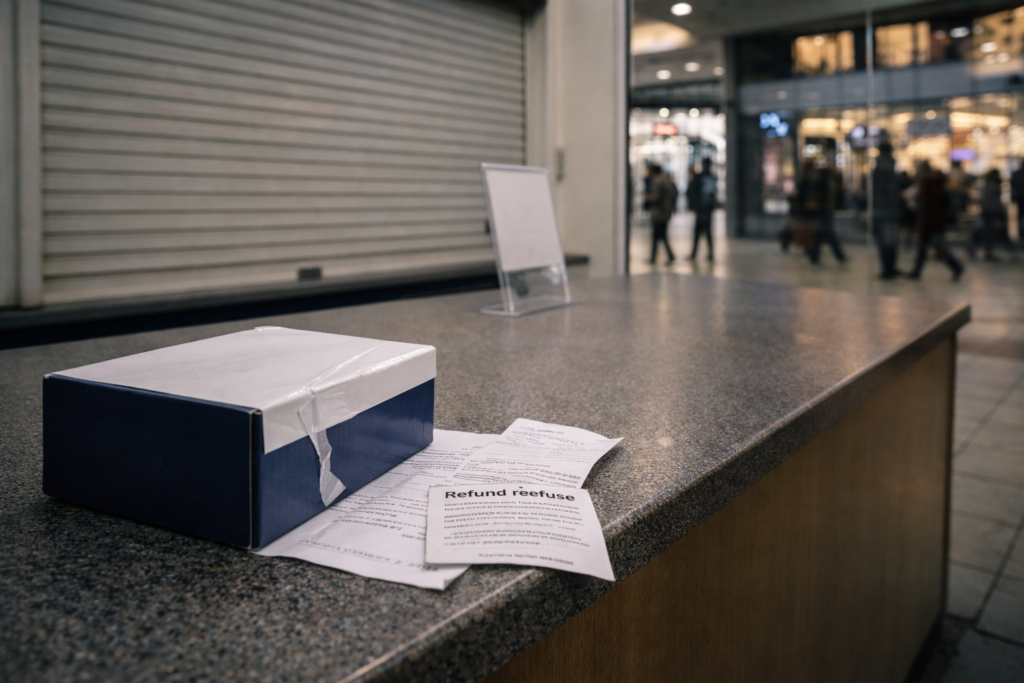
What it looks like
A refund refusal by a company in the UK usually starts with a short email: “Refund not possible”, “Outside policy”, or “You agreed to terms”. In households, it tends to show up as money missing from the budget for weeks, repeated chasing, and a growing trail of screenshots and reference numbers. Common patterns include being offered store credit instead of a refund, being told to deal with the manufacturer, or being asked to return an item at the customer’s cost even when it arrived faulty.
For services (gyms, broadband, trades, events), the refusal often comes after cancellation: the company says notice wasn’t given correctly, the contract has a minimum term, or the booking was “non-refundable”. For online purchases, the refusal is frequently linked to claims that the item was “used”, “not in original packaging”, or returned “too late”.
Common reasons for refusal
Check the purchase type
The rules differ depending on whether it was bought online/at a distance, in-store, or as a service. Distance purchases commonly involve a 14-day cancellation window for a change of mind, but there are exceptions (for example, personalised goods and some sealed items once unsealed). In-store purchases are different: a change-of-mind refund is usually down to the retailer’s policy, but faults are covered by consumer law.
Spot “policy” misuse
A frequent UK outcome is a company quoting “policy” as if it overrides legal rights. Policies can add benefits (longer returns windows), but they cannot remove statutory rights for faulty goods or misdescribed items. Another common tactic is insisting only store credit is available even where a refund is the appropriate remedy.
Look for fault disputes
Many refusals hinge on whether the item is considered faulty, damaged by the customer, or simply “wear and tear”. Retailers often ask for photos, a report, or inspection. Where the fault appears quickly (days or a few weeks), the dispute usually centres on whether it was present at purchase.
Watch for service contract traps
With subscriptions and services, refusal often relies on cancellation terms: notice periods, minimum terms, or “admin fees”. Another common issue is poor service (missed appointments, partial delivery, or substandard work) where the company claims it has “done enough” to charge in full.
Consider payment method limits
Outcomes vary depending on how payment was made. Card payments can open chargeback routes; credit card purchases over £100 may involve Section 75. Bank transfers and cash are harder: the dispute is then mostly direct negotiation and formal complaint routes.
Fix it step by step
Gather proof quickly
Collect the order confirmation, receipt, delivery confirmation, and any terms shown at checkout. Add photos or a short video showing the fault, packaging condition, and serial numbers. Save chat logs and emails. In UK disputes, the deciding factor is often a clear timeline: order date, delivery date, first contact date, and return date.
Identify the right remedy
Match the request to the situation. If the item is faulty, ask for repair, replacement, or refund as appropriate. If it was a distance purchase and the cancellation window applies, state that it is a cancellation and request a refund. If the service wasn’t delivered as agreed, request a repeat performance or a price reduction. Keeping the request aligned to the scenario reduces the “policy” pushback.
Write a firm message
Send a short complaint email (or webform message) that includes: order number, what happened, what remedy is requested, and a deadline (usually 14 days). Avoid long explanations. UK companies tend to respond better to a structured message than to multiple chasers. If the company has a complaints process, use it and ask for a complaint reference.
Return items correctly
If returning goods, use tracked postage and keep the receipt. Photograph the parcel before sending and keep proof of weight where possible. A common UK problem is “return not received” claims; tracking and parcel photos usually prevent stalemates. If the company provided a returns label, keep a copy of it and the drop-off receipt.
Escalate to the payment route
If the company refuses or delays, consider the payment method. For debit card and many credit card payments, chargeback can be an option through the bank or card provider. For credit card purchases (or linked finance) where the total purchase price is over £100 and under £30,000, Section 75 may apply, making the card provider jointly liable. Provide the same timeline and evidence pack to the bank; this is usually what speeds up decisions.
Use formal dispute channels
Check whether the company is part of an Alternative Dispute Resolution (ADR) scheme or an ombudsman route (common in travel, energy, telecoms, and some retail sectors). If the company is regulated, the complaint path is often clearer and time-limited. If not, a “letter before action” can sometimes prompt settlement, especially where evidence is strong and the amount is clear.
Keep a clean record
Maintain one document (notes app is fine) with dates, names, and what was said. UK cases often turn on small details: the date a fault was reported, whether the company offered a repair, or whether the return was within the stated window. A clean record also helps if the dispute moves to a bank claim or small claims.
If it’s left unresolved
Expect delays and drift
When a refusal is ignored, the usual outcome is “case drift”: the company stops replying, the return window passes, and the customer is left with an item they cannot use or a service they are still being billed for. For subscriptions, missed cancellation steps can lead to ongoing direct debits and late payment markers if the account falls into arrears.
Risk losing leverage
Evidence becomes harder to gather over time: packaging is thrown away, faults become harder to show, and messages get lost. Payment disputes also have time limits. Many UK consumers only discover these limits after weeks of back-and-forth, when the bank says the window has closed.
Face knock-on costs
Common knock-ons include paying for replacement items, paying return postage unnecessarily, or covering temporary alternatives (like buying another appliance). For services, it can mean paying for a second provider to finish work or fix poor workmanship.
When to escalate properly
Recognise the red flags
Escalation is usually justified when: the company repeats “policy” without addressing the facts, refuses to provide a complaint reference, claims the item was received damaged without evidence, or keeps moving the goalposts (new requirements each time). Another red flag is being told to contact the manufacturer when the contract is with the retailer.
Prepare an evidence pack
Include: proof of purchase, screenshots of the listing/description, photos/video of the issue, return tracking, and a one-page timeline. Add copies of any promises made (delivery dates, “free returns”, “cancel anytime”). This pack is what banks, ADR schemes, and complaints teams usually ask for.
Use related routes
If the dispute is part of a wider pattern of delays and refunds, it can help to compare how other UK processes work and what evidence is expected. For example, the same “timeline + reference numbers” approach is often used when an HMRC refund is delayed, even though the organisation and rules differ.
FAQ
Ask for a refund or replacement?
If the item is faulty, the remedy depends on circumstances and timing. Retailers commonly offer repair or replacement first; a refund is more likely where repair/replacement is not possible, fails, or is disproportionate.
Can a company refuse a refund?
It can refuse a change-of-mind refund for in-store purchases if its policy says so, but it cannot refuse remedies for faulty or misdescribed goods by relying on “policy”.
Do returns need original packaging?
Original packaging is helpful but not always required. Companies often ask for it; the key point is returning the item in a reasonable condition with all parts where possible.
What if the company offers only…
Store credit is common for goodwill or policy returns. Where a refund is due (for example, a valid cancellation or a fault remedy), store credit is not usually an equivalent substitute unless agreed.
How long should a refund take?
Many UK businesses process refunds within 5–10 working days after receiving the return, but delays happen. If the company has the item and keeps delaying, move to a formal complaint and consider the payment route.
Is chargeback guaranteed?
No. Chargeback is a card scheme process and depends on evidence and timing. It is still often effective when a company is unresponsive or refuses to engage.
Before you move on
Put everything into one folder today: receipt, screenshots of the listing and returns policy, photos/video of the issue, and proof of return tracking, then send one final complaint message with a 14-day deadline and a clear remedy request. If you felt pushed to accept credit notes or told the refund window was closing immediately, that’s often a sign the process wasn’t handled properly.
Get help with the next step
If the company is still refusing, send the key details and evidence list and get support on the best escalation route at https://ukfixguide.com/contact/.





5 thoughts on “Refund refused by company”