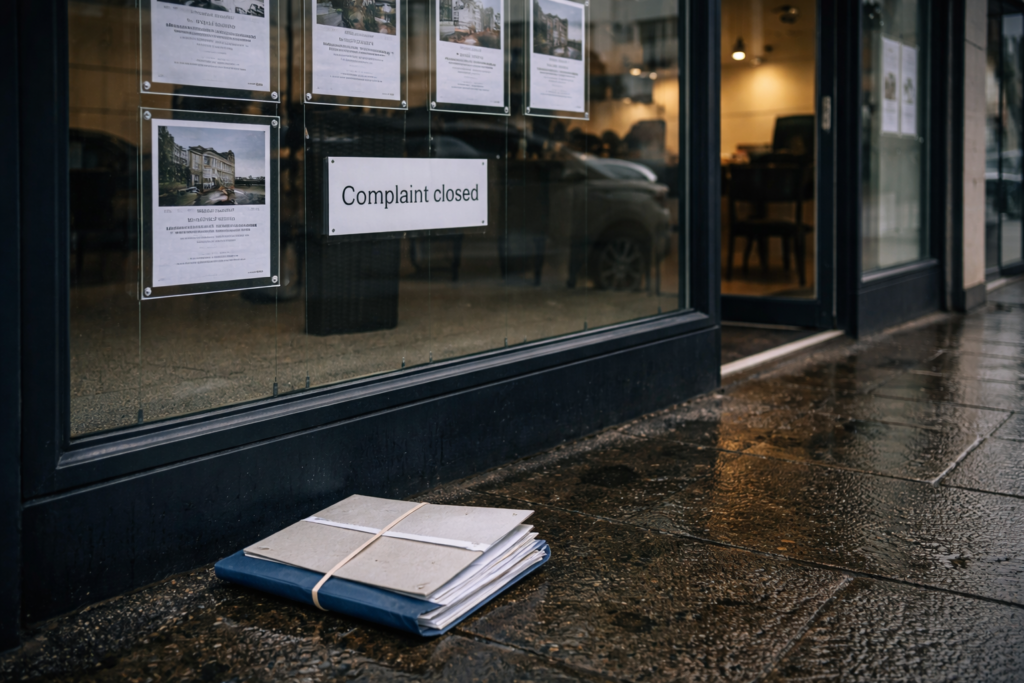
Reply in writing today asking the letting agent to reopen the complaint and confirm the next stage, then send the same message to the landlord if contact details are available. If nothing is done, the issue usually drifts until the tenancy ends and the practical problem remains unresolved. Keep the request narrow: what was complained about, what remedy is being sought, and what response is expected by a set date. If the agent still refuses to deal with it, move to the agent’s official redress scheme route once the agent’s complaints process has been exhausted.
What the problem is
A letting agent in the UK may mark a complaint as “closed” even though the underlying issue has not been fixed, no meaningful decision has been given, or the proposed remedy is unclear. This tends to hit tenants during an active tenancy when repairs, damp, safety concerns, or billing disputes are ongoing, and it can also affect landlords when rent handling or management standards are in question. It often appears after a partial response that answers only part of what was raised, or after the agent says the matter is “resolved” because a contractor was booked, a note was added to the file, or a generic apology was issued. It can also happen after a deadline passes with no update and the agent treats silence as closure.
In day-to-day UK renting, this usually shows up at the point where the tenant expects a final written outcome and next steps, but instead receives a brief email stating the complaint is closed, sometimes with no reference number, no escalation route, and no clear decision. Where the complaint relates to repairs, closure can be used to push the issue back into “maintenance” without acknowledging the complaint itself. Where the complaint relates to conduct, fees, or deposit handling, closure can be used to avoid a written position that could later be relied upon.
Why this happens
Letting agents are set up to prioritise day-to-day property management tasks, and complaints can be treated as an administrative burden rather than a tracked process with clear outcomes. A common cause is internal targets: staff are encouraged to clear open cases, and “closing” a complaint is an easy way to reduce the visible backlog. Another cause is role confusion between the property manager, the maintenance team, and the complaints handler, where each assumes the other is dealing with it. Some agents also treat a complaint as closed once they have sent any response, even if it does not address the remedy requested.
Business behaviour can be predictable: if the complaint is about repairs, the agent may keep repeating that contractors have been chased, while avoiding a decision about compensation, rent reduction, or timeframes. If the complaint is about service standards, the agent may frame it as a misunderstanding and close it without investigating. If the complaint is about money, the agent may insist it is “policy” and close the file rather than explain the basis for the charge or provide supporting documents. A typical organisational response pattern is that the first reply focuses on process language and deflects responsibility to a third party.
This happens because closing a complaint reduces immediate pressure and limits written admissions, while leaving the tenant to keep chasing through informal channels. If the tenant gives up, the agent avoids the cost of remedial work, refunds, or management time. If the tenant persists, the agent may still try to keep the dispute in routine email threads rather than in the formal complaints track that leads to external escalation.
Your rights in UK
Practically, a closed complaint is not the end of the matter if the issue is unresolved and the agent has not provided a final response that deals with the points raised. The strongest leverage usually comes from insisting on a clear written outcome: what was decided, what evidence was considered, what will be done, and by when. Keeping everything in writing matters because agents often change staff, and verbal promises tend to disappear when the file is “closed”.
It also helps to separate two threads: the underlying issue (for example, repairs) and the complaint about how the agent handled it. The underlying issue can keep being chased, but the complaint should be pushed back into the agent’s formal process so there is a final response suitable for escalation. Where the landlord is responsible for the property, copying the landlord can shift incentives, because the landlord may not want a dispute escalating to a redress scheme or affecting future letting arrangements. A typical real UK outcome is that the agent reopens the complaint and offers a limited remedy once escalation is clearly signposted.
What usually works is being specific and measurable: a deadline for a written final response, a request for the agent’s complaints policy and redress scheme details, and a short summary of what remains unresolved. Avoid arguing every historical detail in each email; agents tend to respond better when the outstanding points are numbered and the remedy requested is clear. If the agent claims the complaint is closed because “nothing further can be added”, the practical counter is to ask for the final response letter and confirmation that internal escalation is complete, because that is what external schemes expect to see.
Official basis in UK
The practical route for a closed-without-action letting agent complaint is the letting agent redress scheme system required for agents in England. In practice, the agent must belong to an approved redress scheme, and once the agent’s own complaints process has been followed (or a final response is issued), the complaint can be taken to the scheme for an independent decision. The scheme will typically look for evidence that the agent was given a fair chance to resolve the issue, that the complaint is within scope, and that the remedy sought is clear and proportionate. The redress scheme process is most effective when the complaint is about service failures, communication, handling of repairs, fees, or administrative errors, rather than trying to force a landlord to carry out major works through the scheme.
Details on how to complain about a letting agent and the redress requirement are set out in GOV.UK guidance, which is useful when an agent refuses to provide scheme membership information or treats a complaint as closed without a final position.
Evidence that matters
Evidence should show three things: what was raised, what the agent did or did not do, and what impact it had. The most persuasive material is usually the simplest: dated emails, screenshots of portal messages, repair reports, photos, and any written promises about timeframes. If the complaint relates to money, keep statements, invoices, rent schedules, and any breakdowns the agent provided. If the complaint relates to repairs, keep a timeline of reports and access attempts, including dates contractors were cancelled or no-showed.
What not to do is flood the agent with dozens of attachments without a summary; that often leads to “we cannot process this” responses. Keep the evidence organised by date and link each item to a specific complaint point. Also avoid threats that cannot be followed through, because agents often respond by closing the conversation rather than engaging.
Checklist to gather before pushing for reopening:
- The original complaint message and any reference number.
- The agent’s closure email or message and the date received.
- A short timeline of key events with dates (reports, visits, promises).
- Supporting documents (photos, invoices, contractor messages) tied to each point.
Three common mistakes seen in UK cases are sending only phone-call summaries with no written follow-up, mixing new issues into the old complaint so the agent claims it is a different matter, and accepting “closed” without asking for the final response and redress scheme details. One thing not to do yet is start a public review campaign as a substitute for the formal process, because it can harden positions and does not create the paperwork needed for escalation.
Steps to take next
Reopen request
Send a short written request to reopen the complaint and ask for a final response. Include the complaint reference (or the date it was first raised), list the unresolved points, and state the remedy being sought. Give a clear deadline for a written final response, and ask for the agent’s complaints policy and the name of the redress scheme they belong to. If the landlord’s contact details are held, send the same message to the landlord so the landlord is aware the complaint is being escalated.
Use official process
Use the agent’s official complaints process only, even if staff suggest keeping it “informal” by email. The complaints process is usually on the agent’s website under “Complaints”, “Customer care”, or “Terms of business”, and it may also be in the tenancy paperwork. Prepare the information the process normally asks for: the property address, tenancy dates, the complaint summary, what resolution is wanted, and copies of key evidence. Do not copy and paste long chat logs into the form; attach the key items and keep the narrative short.
Wait timeframe
In UK practice, agents commonly take up to 15 working days to send a substantive response, and a final response can take longer if they say they are investigating. If the agent gives a date, hold them to it and follow up the next working day after the deadline with a single-line chaser asking for the final response. Keep the tone factual and avoid adding new issues in the chaser.
Escalate properly
If there is no final response by the deadline given in the complaints policy (or by the date the agent promised), escalate by writing to the agent’s designated complaints contact asking for confirmation that the internal process is exhausted and requesting the redress scheme details. Then submit the complaint to the agent’s redress scheme using the scheme’s official complaint route found on the scheme’s own website, attaching the final response if available, or evidence that a final response was not provided within the stated timeframe. Escalation should be done in writing and kept to the same complaint points, because schemes tend to reject complaints that shift mid-way.
Change approach
If the underlying issue is urgent disrepair or safety-related and the agent keeps treating it as “maintenance” while closing the complaint, switch strategy by separating the repair request from the service complaint. Continue chasing the repair in a dedicated thread with dates and access availability, while keeping the complaint thread focused on the agent’s handling and the remedy sought for poor service. Where the dispute is mainly about money, ask for a written breakdown and supporting documents first, then keep the complaint focused on the gap between what was charged and what was agreed.
Checklist to prepare before submitting through the official complaints route:
- Property address and tenancy start date.
- Complaint timeline with the key dates only.
- What resolution is being requested in one sentence.
- Copies of the closure message and the most relevant evidence.
The issue is usually resolved when the agent issues a written final response that offers a clear remedy or confirms redress scheme details so the complaint can move forward.
Related issues on this site
If the closed complaint is tied to a deposit dispute at the end of the tenancy, the next problem often becomes delays or missing paperwork, and it may help to compare the situation with tenancy deposit not returned. If the complaint was closed while repairs are still outstanding and the property condition is worsening, the situation can overlap with landlord not fixing repairs, especially where the agent keeps shifting responsibility between teams. Those routes become relevant when the complaint process is being used to stall rather than to decide.
Get help with the next step
Contact UKFixGuide — Get help drafting a reopen-and-final-response request that matches what redress schemes usually expect to see.