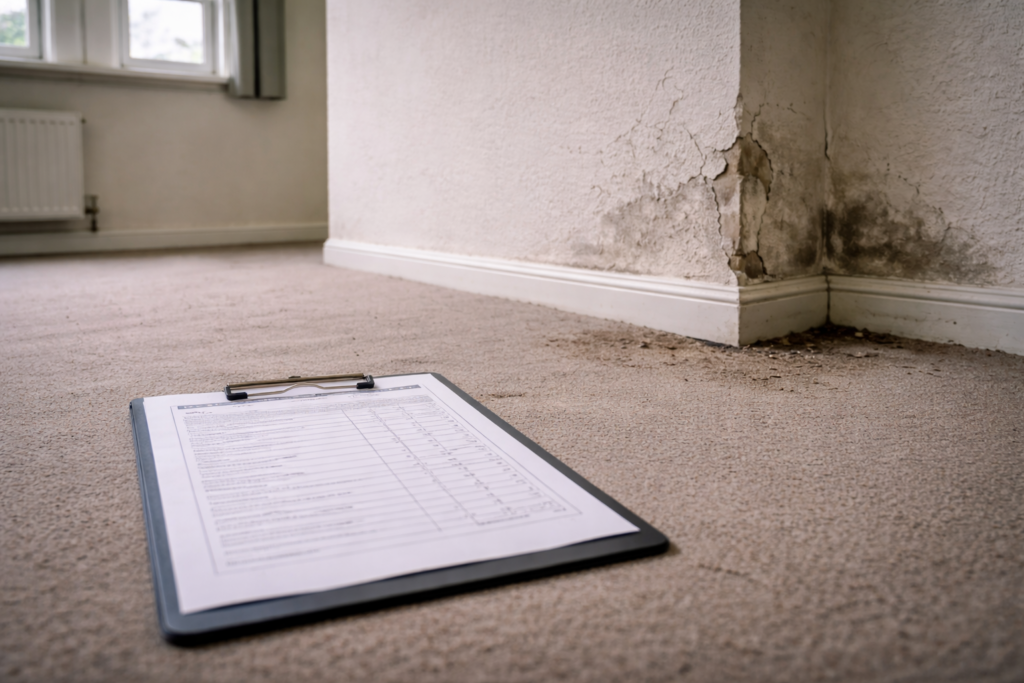
Reply in writing to the landlord or agent today, pointing out the existing damage and asking for the check-in evidence they rely on. If nothing is done, the deposit is often treated as agreed to the landlord’s version and the dispute becomes harder to win. Keep the reply calm, stick to facts, and ask for the deposit to be handled through the tenancy deposit scheme process. If the other side refuses to engage, move straight to the scheme’s dispute route rather than arguing back and forth.
What the problem is
This usually comes up in UK private rentals at the end of a tenancy, when the check-out report or proposed deductions rely on an inventory that does not reflect damage that was already there at move-in. Tenants tend to notice it after receiving a partial response to a complaint, or when an agent sends a “final” list of deductions with a short deadline to accept. It can also appear when a landlord changes managing agents and the new agent treats the inventory as complete even though earlier emails or photos show defects. The practical issue is that the paperwork being used to justify deductions does not match the condition that was actually handed over.
It affects tenants who took photos at move-in but did not get the inventory amended, and also tenants who did respond but were told “noted” without any change to the document. It often surfaces at the point the deposit return is being processed, when the landlord asks for money for cleaning, scuffs, stains, chipped worktops, worn carpets, or marks on walls that were present from day one. The pressure tends to increase when the tenancy has ended and the tenant needs the deposit back for a new place.
Why this happens
In many UK lettings, the inventory is treated as the default record even when it is rushed, generic, or produced by a third-party clerk who did not spend long in the property. If the check-in report is vague (“good condition”, “minor marks”) it gives room for the check-out report to describe the same issue as new damage. Where the landlord is planning redecoration or replacement anyway, deductions can be framed as “tenant-caused” to shift costs onto the deposit.
Agents also have an incentive to close files quickly: a simple deduction proposal is faster than a careful comparison of check-in photos, tenant emails, and maintenance history. If the tenant challenges, the response can be a repeat of the same line that the inventory is “signed and accepted”, even where the tenant replied within days with corrections. A typical organisational response pattern is to ask for more proof while not providing any of the evidence being relied on.
Another common driver is missing maintenance records. If a repair was reported early in the tenancy but never fixed, the end-of-tenancy paperwork can treat the resulting deterioration as tenant damage. Where there was a mid-tenancy inspection noting marks or wear, that note may not be carried into the check-out process, so the check-out report reads as if the issue appeared at the end.
Your rights in practice
The strongest practical position comes from showing that the damage existed at move-in or arose from normal use rather than misuse. In UK deposit disputes, the landlord usually needs to show the property’s condition at the start, the condition at the end, and why the tenant should pay for the difference. If the check-in inventory is incomplete or contradicted by dated photos, emails, or repair requests, the landlord’s claim often weakens.
Leverage tends to come from using the tenancy deposit scheme process rather than negotiating deductions informally. Schemes look for clear evidence and tend to discount claims that are unsupported, inflated, or based on “betterment” (ending up with something newer than before). A calm, evidence-led reply that asks for the deposit to be returned unless the landlord can evidence the change in condition often moves the discussion from opinion to proof.
Where the landlord or agent refuses to release the deposit unless deductions are accepted, the practical counter is to insist on the scheme’s formal route and stop debating the same points by email. Typical outcomes in UK cases are that unsupported or poorly evidenced deductions are reduced or removed.
Legal or official basis
The relevant official framework is the tenancy deposit protection scheme process used for assured shorthold tenancies in England and Wales, where the deposit must be protected and disputes can be decided using evidence from both sides. In practice, this means the landlord cannot simply keep the deposit because an inventory says so; they must justify deductions with check-in and check-out evidence, invoices or quotes, and a clear link to tenant responsibility. The scheme’s adjudication route is designed for exactly this kind of disagreement, and it usually focuses on whether the starting condition is proven and whether the claimed cost is reasonable for the age and condition of the item.
Use the official overview on GOV.UK guidance to confirm the deposit scheme route and the basic steps for getting the deposit back or raising a dispute.
Evidence that matters
Evidence works best when it is dated, specific, and tied to the exact item being claimed for. The most persuasive bundle usually includes move-in photos that clearly show the same mark or defect, a copy of the check-in report, and the email or message sent at the time pointing out the issue. If there were repairs reported, include the repair request and any response, because it shows the landlord knew about the problem during the tenancy.
Also collect anything that shows the condition at move-out, especially if the check-out report is vague or uses broad phrases. If the landlord is claiming for replacement, evidence of the item’s age helps, because adjudicators often reduce awards where an item was already worn. Keep screenshots of the deposit protection certificate or scheme reference, and keep all communication in one thread where possible.
One thing not to do yet is to agree to a partial deposit return “as a compromise” if it is being presented as final settlement, because it can be treated as acceptance of the deductions.
What to collect
Gather the documents and images that show the timeline from move-in to move-out, and keep them in their original format where possible.
- Check-in inventory and any tenant amendments sent at the start
- Dated move-in photos or video showing the existing damage
- Repair reports, inspection notes, and landlord/agent replies
- Check-out report and dated move-out photos
- Deposit scheme certificate or reference details
Common mistakes
These errors tend to weaken otherwise good disputes.
- Sending only selected close-up photos with no context showing location in the property
- Arguing about fairness without addressing the check-in versus check-out evidence
- Paying for repairs or cleaning without written agreement and then expecting reimbursement
Steps to take next
Start with a written reply that is short, factual, and structured around evidence. Ask the landlord or agent to identify exactly which line of the check-in inventory they rely on for each deduction, and to provide the check-in photos (if any) that support their claim. State that the damage was pre-existing and attach a small selection of the clearest dated images, then offer to provide the full set if needed.
Send a rebuttal
Use email so there is a clear record, and keep the tone neutral. A practical format is: item, what is being claimed, what the check-in evidence shows, what the tenant evidence shows, and the requested outcome (return of deposit or removal/reduction of that deduction). If the dispute is about condition records, it can help to compare the inventory wording to the photos rather than debating general standards of cleanliness or wear.
Request scheme details
Ask for the name of the deposit protection scheme and the deposit ID if it is not already available. If the landlord says the inventory was “accepted”, reply with the date the corrections were sent (if applicable) and attach that message. Where the dispute is really about whether the inventory captured existing defects, refer to the same decision point that often appears in an Inventory dispute at end of tenancy: move the discussion onto what evidence exists for the start condition, not what the landlord now believes happened.
Use official process
If the landlord will not return the undisputed amount, or insists the tenant must accept deductions to get anything back, use the scheme’s official deposit return and dispute process only. The scheme’s website will have the correct route once the scheme name is known; it is usually found on the deposit certificate, the prescribed information, or the original tenancy paperwork. Prepare the information the scheme typically asks for, but do not send unnecessary personal data beyond what the scheme requires.
- Tenancy dates and property address as shown on the deposit record
- Deposit amount and the proposed deductions list
- Check-in and check-out reports (PDFs if possible)
- A small set of key photos with dates and brief captions
- Any emails showing the damage was reported early
The normal response timeframe for an agent or landlord to engage once the scheme process is started is within a couple of weeks, and delays are often caused by missing documents or slow replies. If there is no response or the landlord will not cooperate, escalate by starting the scheme’s formal dispute route as soon as the scheme allows, uploading the evidence bundle and a short timeline. Change strategy if the landlord keeps repeating the same point without providing check-in proof; stop negotiating and let adjudication decide based on evidence.
This issue is usually resolved in UK cases once the dispute is formally lodged and both sides are required to submit evidence to the scheme.
Related issues on this site
If the deductions are being framed as tenant-caused damage rather than a record-keeping problem, the decision often turns on responsibility and wear versus damage, which is covered in Landlord claims damage is tenant’s responsibility. Where the landlord is also slow to respond or keeps pushing deadlines without moving the deposit process forward, it can help to treat it as a delay-and-pressure pattern and focus on the scheme timetable rather than the email back-and-forth. These related angles matter most when the inventory is vague but the landlord is confident about deductions, or when the dispute is widening beyond the original pre-existing defect.
FAQ and quick checks
Signed inventory weight
A signed inventory with existing damage can still be challenged if the signed inventory missed defects and the tenant has dated move-in evidence. The key is showing the same issue was present at the start.
Photo evidence strength
Photo evidence for pre-existing wall marks works best when it shows the location clearly and is dated close to move-in. Blurry close-ups without context are usually less persuasive.
Partial return risks
Partial deposit return offered as final settlement can reduce options if it is accepted as agreement to deductions. If unsure, keep the deposit in the scheme process until the dispute route is clear.
Cleaning deduction limits
Cleaning deduction for already-dirty carpets is often reduced where check-in notes or photos show the same condition. The claim usually needs a clear before-and-after comparison.
Before you move on
Put the dispute into the deposit scheme process with a short, evidence-led summary and keep copies of everything sent, because the decision normally turns on what can be proved rather than what feels fair. Time pressure can show up as being pushed to accept quickly in exchange for a faster payout.
Get help with the next step
Contact UKFixGuide — Share the wording of the proposed deductions and what move-in evidence exists, and the next message can be shaped to fit the deposit scheme process.