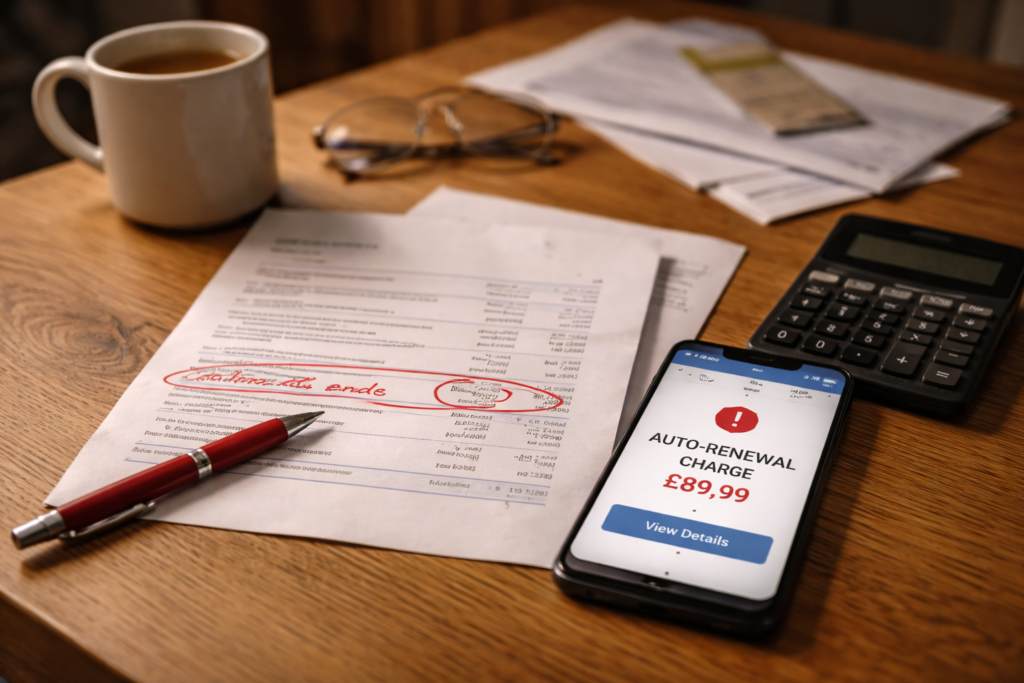
Contact the company today and ask for the cancellation date to be confirmed in writing, then request a refund of the auto-renewal charge and any related fees. If nothing is done, the charge is usually treated as accepted and further renewals or debt-chasing can follow. Keep paying only what is genuinely undisputed to avoid service disruption, but make the renewal amount clearly “in dispute” in writing. If the payment was taken by card, prepare to use the card provider’s dispute route if the business refuses to put things right.
Most UK cases settle once the business sees clear proof of cancellation and a firm request for refund with a deadline. If the company continues to ignore the issue, escalation through the payment route often changes the pace quickly.
What the problem is
This problem shows up when a subscription, membership, app, broadband add-on, insurance add-on, gym plan, or similar service takes an auto-renewal payment even though cancellation was already requested. In UK complaints, it often appears after a customer has used an online account button, sent an email, or spoken to an agent, then later spots a renewal on a bank statement or gets an invoice. It can also happen when a “cancel” request was made near the end of a minimum term, but the business treats it as a request to cancel at the next renewal date rather than immediately.
It commonly reaches a frustrating stage after the first complaint has been raised and the business replies with a partial response such as “cancellation processed” while still refusing to refund the renewal charge. Another common point is after a promised callback or “48-hour update” has passed and the renewal is still showing as active in the account. People tend to notice it most when a renewal is larger than expected, when a discount ends, or when a payment method changes and the renewal becomes more visible.
Why this happens
The most common cause is a mismatch between what the customer believes was cancelled and what the business system recorded. Online cancellation flows sometimes end with a confirmation screen but no email, or the confirmation email goes to spam, leaving the business later claiming there is “no record”. Phone cancellations can be logged as a note rather than a status change, especially where the agent is measured on retention or has to follow a script that offers alternatives before completing cancellation.
Another frequent cause is timing rules buried in account terms, such as needing notice before a billing date, or cancellation applying at the end of a paid period. Businesses also sometimes treat cancellation as “stop future renewals” but still take a payment that was already queued, then ask the customer to wait for a refund process that never starts unless chased. A typical organisational response pattern is that first-line support repeats a template response and asks for the same evidence again, while the billing team remains unreachable until a formal dispute is raised.
There is also an incentive issue: auto-renewal revenue is predictable, and reversing it creates admin work and can affect internal targets. That can lead to slow responses, requests for unnecessary screenshots, or attempts to offer credit instead of a refund even when the service is no longer wanted.
Your UK position
In practice, the strongest leverage comes from showing a clear cancellation instruction and a clear renewal charge that happened after that instruction. UK businesses usually respond better when the request is framed as a billing error to be corrected, rather than a debate about policy. A short written timeline, a copy of the cancellation confirmation (or proof the cancellation route was used), and a firm deadline for refund tends to move the complaint out of the “retention” loop.
If the service was cancelled but access continued, the business may argue there was still benefit. The practical counter is to point out that continuation was not requested and that the renewal was taken without agreement to continue. Where the business claims “notice required”, it often helps to ask them to show exactly where the notice rule was presented at sign-up and at the point of cancellation, and to explain why the account showed cancelled (if it did) while billing continued.
Payment leverage matters. When a card payment is involved, UK firms are often more responsive once they understand the charge is likely to be disputed through the card provider, because it creates extra work and can affect their payment processing. If the payment was by Direct Debit, the bank refund route is usually faster than waiting for internal billing teams to respond.
Official UK basis
If the renewal was taken by Direct Debit, the most practical official basis is the Direct Debit Guarantee, which is a UK banking scheme that allows a payer to ask their bank for an immediate refund for an incorrect or unauthorised Direct Debit. In real use, the bank normally asks for the date and amount of the payment and the reason it is wrong, then processes the refund while the business can later challenge it if they believe it was valid. This route is particularly effective where cancellation was already given, where the amount changed without proper notice, or where the payment date was unexpected.
Use the bank’s own Direct Debit dispute process (often in-app, by phone, or in branch) and keep the explanation factual: cancellation date, renewal date, and why the payment should not have been taken. Supporting information such as cancellation emails can help, but the bank usually proceeds based on the account holder’s report and then follows up if needed. GOV.UK guidance on Direct Debits and consumer payments can help when a bank agent is unfamiliar with the refund route: GOV.UK guidance.
Evidence that matters
Evidence is less about proving every detail and more about showing a clean sequence: cancellation instruction, business acknowledgement (or proof the cancellation route was used), then the renewal charge. UK complaints handlers tend to respond best to documents that can be verified quickly, like bank statements, confirmation emails, and screenshots showing account status and dates.
Collect the cancellation proof available, even if it feels incomplete. A screenshot of the final cancellation page, an email subject line with a timestamp, or a chat transcript reference number can be enough to shift the conversation. If the business claims cancellation was “not completed”, ask them to confirm what step was missing and provide the audit trail from their side.
What not to do is just forward a long email chain without a summary, because it slows down triage and increases the chance of a template response. Avoid editing screenshots in a way that could be questioned; keep originals and, if needed, add a separate note explaining what the image shows.
Key documents
Keep a simple pack ready so the complaint can be escalated without delay.
- Bank statement line showing the renewal charge and date
- Cancellation confirmation email, screenshot, or chat transcript reference
- Account page screenshot showing status (cancelled/active) and renewal date
- Any message from the business acknowledging cancellation or offering a refund
Common errors
These are the mistakes that most often weaken an otherwise straightforward refund request.
- Relying on a phone call with no date, time, or agent name recorded
- Accepting “account closed” wording without checking whether billing is also stopped
- Letting the dispute drift past the next billing cycle so another renewal is taken
Do not yet
Do not cancel the payment method before securing written confirmation that the subscription is ended and the renewal is being refunded, because it can trigger arrears processes while the account still shows active.
What to do next
Send timeline
Write a short complaint to the company’s official complaints channel (not a social media message) with three lines: when cancellation was requested, when the renewal was taken, and what outcome is required. Ask for written confirmation that the subscription is cancelled, a refund of the renewal charge, and removal of any late fees or collections flags linked to it. Include copies of the key evidence and set a clear deadline for a response.
Stop further renewals
Log into the account and check whether auto-renew is still enabled, whether there is a “next billing date”, and whether there are multiple linked products. If the cancellation route is unclear or keeps looping, use the provider’s official cancellation process again and save screenshots of each step. Where the issue looks like a retention flow or unclear notice period, it can help to compare it with known patterns described in Auto-renewal trap explained so the complaint focuses on the billing outcome rather than arguments about wording.
Use bank route
If the renewal was taken by Direct Debit and the business does not confirm a refund promptly, contact the bank and raise a Direct Debit Guarantee refund request using the bank’s official route. Prepare the payment date, amount, the company name as it appears on the statement, and the cancellation date. The bank process is usually handled the same day or within a few working days, depending on the bank and how the request is made.
Card disputes
If the renewal was taken by debit or credit card, use the card provider’s official charge dispute process (often called a card payment dispute or chargeback) rather than sending repeated emails to support. Provide the cancellation proof, the renewal transaction details, and the written refusal (or lack of response) from the business. Card disputes commonly take a few weeks to run, and the provider may ask whether the merchant was contacted first, so keep the complaint email and any ticket number.
Escalate properly
If there is no meaningful response from the business within 14 days, escalate through the same official complaints process by replying to the complaint thread and stating that the matter will be pursued through the bank/card dispute route unless the refund is confirmed in writing. If the business replies but only offers credit, decide based on whether the service is still needed; if not, repeat that a refund is required and that the subscription must remain cancelled. This issue is usually resolved in UK cases once the business confirms cancellation in writing and the refund is processed or the bank reverses the payment.
Related site issues
If the renewal charge is tied to a wider cancellation problem, such as a provider insisting the contract cannot be ended or claiming a notice period that was not clearly presented, the steps in Mobile contract cancellation issue can be relevant. Where the renewal is bundled with another service (for example, a handset plan plus a subscription add-on), it can help to separate what is genuinely disputed from what is still being used. If the business starts threatening collections while the cancellation is being argued, that becomes a different problem and needs a tighter written record and faster escalation through the payment route.
FAQ
Refund timescale
For an auto-renewal refund after cancellation, many UK firms process it within a billing cycle once the cancellation proof is accepted. If a bank refund route is used for a Direct Debit, the credit often appears quickly and the merchant follows up later if they disagree.
Service access
With cancelling a subscription but still having access, the safest approach is to state in writing that access continuing was not requested and does not mean renewal was agreed. Keep a screenshot showing the account status and the date access was noticed.
Debt letters
For debt collection letters after a disputed renewal, respond once in writing that the amount is in dispute due to cancellation and request all contact in writing. Keep copies of letters and avoid phone discussions that cannot be evidenced.
Notice period claims
For notice period arguments on auto-renewal charges, ask the business to point to where the notice rule was shown at sign-up and at cancellation. If they cannot show it clearly, repeat the request for refund based on cancellation being given.
Before you move on
Keep the next message simple: cancellation date, renewal date, refund request, and a deadline, then use the bank or card dispute route if the business stalls. Time pressure can show up as being pushed to accept credit or “wait for the next billing run” while more renewals are queued.
Get help with the next step
Contact UKFixGuide — If you share the cancellation date, the renewal date, and how it was paid (card or Direct Debit), the next escalation step can be mapped without adding unnecessary risk.