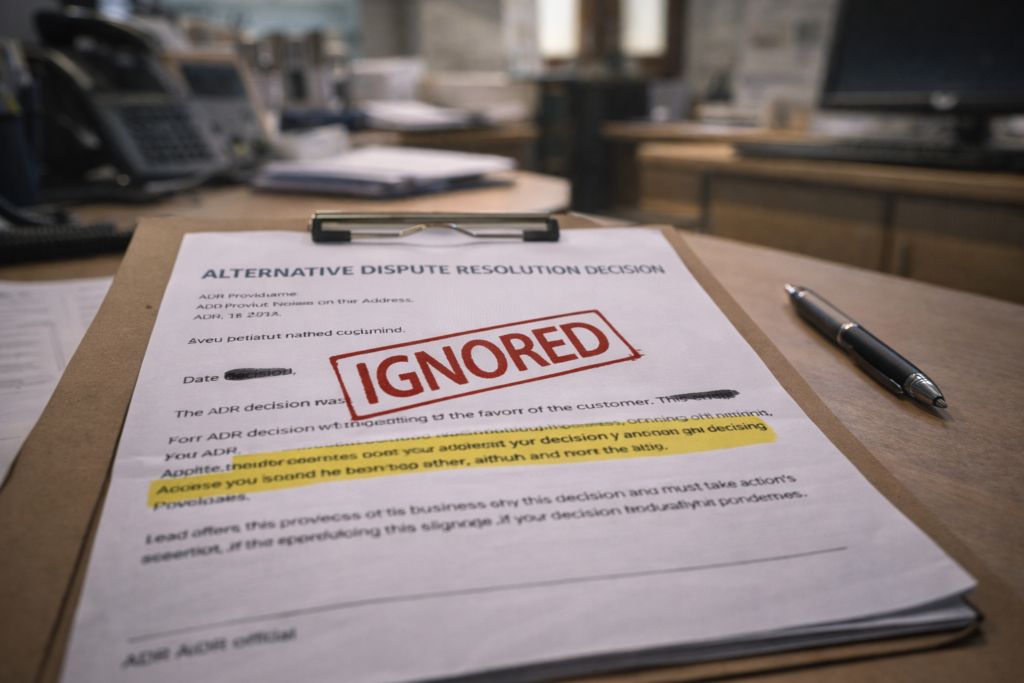
Send the business a final written notice today attaching the ADR decision and giving a clear deadline to comply, then prepare to enforce if they still refuse. If nothing is done, the decision is usually treated as something the business can keep ignoring while the consumer loses momentum and evidence goes stale. Keep the message short, factual, and focused on the remedy the ADR awarded. If payment was involved, check whether a chargeback or card dispute is still possible while enforcement steps are lined up.
A typical UK outcome is that the business pays or performs only after a formal enforcement step is started.
What the problem is
This problem shows up after an Alternative Dispute Resolution (ADR) scheme has issued its decision and the business does not do what it was told to do, such as refunding, repairing, re-performing a service, or correcting a bill. It often affects consumers dealing with traders that operate online, subscription services, home improvement firms, and smaller retailers, but it can happen with larger brands too when the case is passed between teams. The sticking point usually appears after the consumer has already complained directly, escalated to ADR, and received a written outcome that looks final and clear.
In UK cases, the awkward stage is the gap between “decision received” and “remedy delivered”. Many people assume the ADR decision automatically triggers payment or action, then weeks pass with vague updates, partial offers, or silence. This is also the stage where the business may try to reopen the argument, ask for extra documents already provided, or offer a different settlement that is less than the ADR award.
Why this happens
Non-compliance usually comes down to incentives and internal process. Some ADR decisions are binding on the business only if it signed up to be bound, and even where it is meant to comply, the decision still needs a human in finance, operations, or customer relations to action it. If the case is closed by the complaints team but not handed over properly, the remedy can stall. Where the decision requires a service to be redone, the business may not have capacity, may have subcontractors involved, or may prefer to offer a refund lower than the ADR outcome.
Another common cause is that the business treats ADR as a reputational step rather than an enforcement step, so it waits to see whether the consumer will push further. Some businesses also rely on confusion about what the ADR decision actually requires, especially if it sets conditions like returning goods, providing bank details, or allowing access for a repair. A frequent pattern is that the first reply after chasing is polite and non-committal, promising a “review” or “escalation” without a concrete date.
Your rights in practice
The practical position is that an ADR decision is strong leverage, but it is not always self-enforcing. What usually works is treating the decision as a final demand backed by a clear next step that the business understands, such as court enforcement or a card dispute route where available. The aim is to remove ambiguity: restate the exact remedy, the deadline to comply, and what will happen if it does not.
Where the decision requires a refund, the most effective pressure is often a combination of a written deadline and a parallel payment-route action (for example, card dispute) if the time limits still allow it. Where the decision requires work to be done, leverage comes from documenting that access was offered and the business failed to arrange it, so any later claim that the consumer “did not cooperate” is neutralised. If the business tries to renegotiate, the strongest position is to keep pointing back to the ADR outcome and refusing to debate the underlying complaint again.
Official basis in UK
The practical enforcement route for a business that ignores an ADR decision is usually to treat the dispute as unresolved and pursue a court claim for the remedy, using the ADR decision as evidence of what an independent body found. In England and Wales, the Small Claims process is commonly used for consumer disputes of modest value, and it can result in a judgment that is enforceable if the business still does not pay. The ADR decision does not replace the court’s role, but it can help show that the consumer acted reasonably and that the remedy sought is grounded in an independent assessment.
For the court route, the official starting point is the government’s overview of making a court claim, including fees, steps, and what happens after a claim is issued. Use this to understand the sequence and prepare the information needed before sending a final deadline letter. GOV.UK guidance
Evidence that matters
Evidence is about showing three things: the ADR decision, the business’s non-compliance, and the consumer’s reasonable attempts to let the business comply. Keep everything in a single timeline so it is easy to show what was agreed, what was decided, and what did not happen. If the decision required conditions (returning goods, providing details, arranging access), evidence should show those conditions were met or offered.
Collect the ADR decision in full (not just the summary), the original contract or order confirmation, proof of payment, and all messages after the decision. If the business promised dates, keep screenshots or emails showing those dates and the lack of follow-through. If the remedy involves a service visit, keep records of proposed appointment times and any refusal or non-response.
Do not edit screenshots, do not merge messages into a single document that hides timestamps, and do not rely on phone calls without follow-up confirmation in writing. One thing not to do yet is to send repeated daily chasers, because it can muddy the timeline and make it harder to show a clear final deadline was set.
Quick checklist
- ADR decision document and reference number
- Proof of payment and order/contract details
- Post-decision emails, letters, and chat logs
- Evidence of meeting any conditions (returns, access, details)
Common mistakes
Three common mistakes are accepting a partial settlement “to close it” without confirming it matches the ADR remedy, sending bank details by insecure channels without confirming the recipient, and missing the chance to use a card dispute route by waiting too long after the decision.
Steps to take next
Send final notice
Write a short final notice to the business (email is usually fine, plus post if an address is available). Attach the ADR decision, quote the exact remedy, and give a clear deadline date for compliance. State that if the deadline passes without full compliance, the next step will be to start a court claim for the remedy and any allowable costs, using the ADR decision as supporting evidence.
Remove ambiguity
If the ADR decision requires a return, confirm the return method and provide proof of dispatch or collection availability. If it requires access for a repair, offer at least two reasonable dates and ask the business to confirm in writing. If it requires a refund, state the payment method expected and provide only the minimum details needed through a secure channel the business already uses.
Use payment routes
If the dispute is about a paid-for service that was not provided as decided by ADR, consider whether a card dispute is still open while the final notice deadline runs. This is especially relevant where the business is delaying and the consumer risks missing card scheme time limits; the decision point is whether the trader is still refusing to deliver the remedy rather than debating the complaint again. Where the underlying issue is non-performance, the steps and evidence often overlap with Service not delivered — legal options, particularly when deciding whether to pursue a refund route or a court claim.
Start court claim
If the deadline passes, prepare to issue a Small Claims case in England and Wales (or the equivalent local process elsewhere in the UK) for the remedy the ADR awarded. The information to prepare is the ADR decision, the timeline of non-compliance, the amount claimed (or the specific performance sought), and copies of key correspondence. Use the official online claim route referenced on GOV.UK to find the correct process and fees, and keep the claim focused on the remedy rather than re-arguing every detail of the dispute.
Escalate non-response
If there is no response at all to the final notice, escalate by issuing the claim rather than sending further chasers. If there is a response that offers something different, change strategy by asking the business to confirm whether it is refusing to comply with the ADR decision; if it is, proceed to claim. The normal response timeframe after a final notice is that many businesses reply within a couple of weeks, but if the deadline given has passed, escalation should follow immediately in the way stated.
The issue is usually resolved in UK cases when the business receives the court papers and realises the ADR decision will be placed in front of a judge.
Related issues on this site
If the business is trying to keep charging while ignoring the ADR outcome, the dispute may be tied to a rolling contract or renewal that needs stopping at the same time as enforcement. Situations where a consumer agreed to cancel but billing continued can overlap with Auto-renewal trap explained, especially when deciding whether to prioritise stopping future payments before pursuing the past refund. If the ADR decision involved cancellation rights and the trader is disputing the timing, it can also help to separate “ending the contract” from “recovering money” so the next step stays clear.
FAQ and quick checks
Binding decision status
For a binding ADR decision ignored by business, the practical next move is still a final deadline letter followed by enforcement, because the decision alone rarely triggers payment. Keep the focus on compliance rather than debate.
Partial compliance offer
With a partial settlement after ADR decision, ask the business to confirm in writing whether it is refusing the full remedy and why. If the offer is less than the decision, treat it as non-compliance unless the ADR allows variation.
Bank details request
For a refund after ADR decision, provide bank details only through a secure channel already used by the business and only after confirming the recipient. If unsure, ask for refund to the original payment method.
Time limit worries
When worrying about deadlines after ADR decision, set a short compliance deadline and start preparing the claim immediately so escalation is not delayed. Keep evidence organised so issuing a claim is straightforward.
Before you move on
Write down the exact remedy the ADR awarded and the deadline that will be given to the business, then keep every follow-up in one thread so the timeline stays clean. Time pressure can show up when a business pushes for a quick acceptance of a smaller offer before the deadline expires.
Get help with the next step
Contact UKFixGuide — Share the ADR decision wording and what the business has (or has not) done since, so the next escalation step can be set out clearly.