Send a written dispute today confirming the cancellation date and demanding the billing stops, then cancel the payment method only after the dispute is logged. If nothing is done, the provider usually keeps taking payments and may add late fees or pass the balance to collections. Ask for a final bill showing a zero balance and a refund of any payments taken after the cancellation date. Keep everything in writing and set a clear deadline for a response.
Most people see movement once the complaint is framed as “billing after cancellation” with evidence attached and a specific remedy requested. If the company still does not fix it, escalation through the provider’s official complaints route and then the relevant ombudsman-style process is normally the fastest way to force a correction.
What the problem is
This comes up in the UK when a cancellation is accepted (often by email, web chat, or an account portal) but the service keeps billing as if nothing changed. It affects mobile networks, broadband providers, gyms, streaming subscriptions, and other recurring services where payments are taken by Direct Debit or card. It often appears after a customer has already followed the stated cancellation steps and received a “we’ve processed your request” message, then notices another payment taken on the next billing date.
It also commonly shows up after a partial response to a complaint, where the business agrees the cancellation was received but says the account is still “in contract”, “in notice period”, or “pending closure”, without clearly stating the end date and charges. Many people only realise the scale of the issue when a second or third payment is taken, or when a debt letter arrives despite the earlier cancellation acknowledgement.
Why this happens
The usual cause is a mismatch between the cancellation record and the billing system: the cancellation is logged in_toggle but the account status used for billing is not updated in time. Another common cause is the business treating cancellation as “request received” rather than “service ended”, then applying a notice period or minimum term that was not clearly confirmed at the point of cancellation. Where there are add-ons, device plans, or separate service lines, one part can be cancelled while another keeps billing under the same customer profile.
Businesses also have incentives to keep accounts “open” until a final bill is generated, which can create a window where automated billing runs as normal. Customer service teams may be limited to scripted options and cannot directly reverse billing runs, so the first responses can focus on repeating policy rather than fixing the account state. A typical organisational pattern is that frontline support confirms the cancellation but asks the customer to wait for the next bill cycle, even when money is still being taken.
Your UK position
In practical UK terms, the strongest leverage is clear proof of the cancellation acknowledgement and a precise statement of what is being requested: stop billing from a specific date, refund payments taken after that date, and confirm the account is closed (or confirm the genuine end date if a notice period applies). Companies tend to respond better when the complaint is framed around an incorrect charge rather than a general dissatisfaction, because it can be routed to billing corrections.
It usually helps to separate two issues: whether the service should have ended, and whether the payment should have been taken. Even where a notice period exists, the business should be able to show the end date and the basis for any final charge, and it should stop taking payments after that point. If the business has already acknowledged cancellation, it is normally reasonable to insist on written confirmation of the final service end date and a corrected final statement.
Where Direct Debit is involved, UK customers often have a practical safety net through their bank for payments taken in error, but using it at the wrong time can complicate the provider’s internal closure process. The best outcomes usually come from logging the dispute first, then using bank protections if the provider fails to correct the billing promptly.
Official basis in UK
For Direct Debit payments, the most useful official basis is the Direct Debit Guarantee, which is applied by banks and building societies to protect customers when a Direct Debit is taken incorrectly or without proper notice. In practice, this means the bank can refund a payment and then the provider must resolve the underlying billing dispute separately, so it works best when the cancellation evidence is already organised and the provider has been told in writing that billing after cancellation is disputed.
The guarantee is not a substitute for closing the account, so the provider should still be pushed to issue a corrected final bill and confirm the service end date. The bank refund is a tool to stop ongoing loss while the complaint is processed, particularly if the provider keeps taking payments after being told to stop. Details of how the guarantee works and what banks do in real situations are set out on GOV.UK guidance.
Evidence that matters
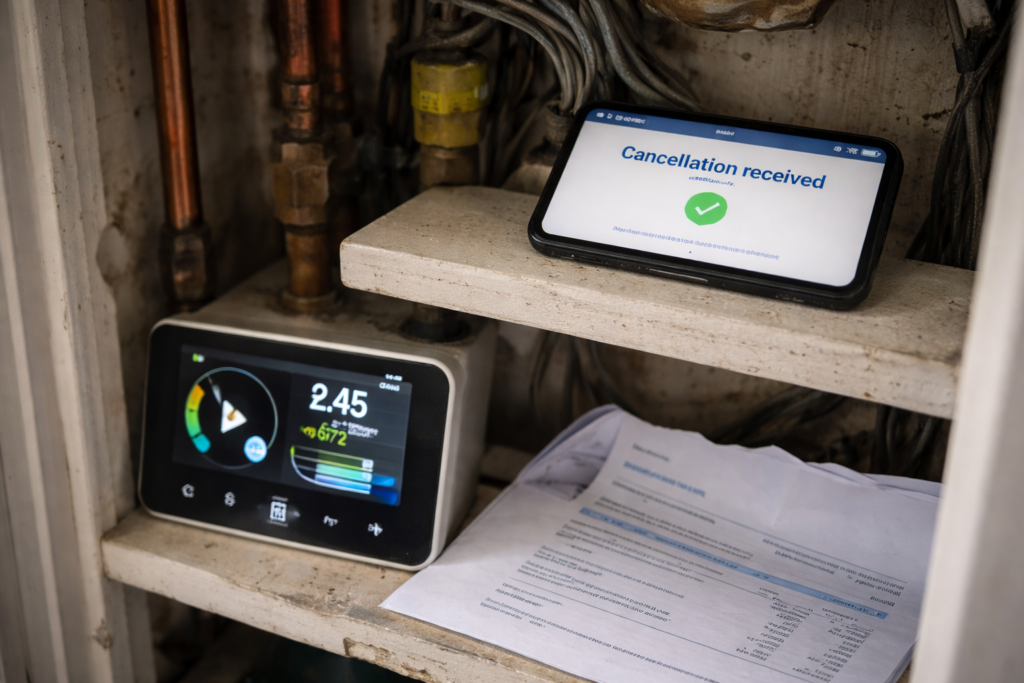
Good evidence is usually simple: the cancellation acknowledgement, the billing proof, and a timeline that shows the mismatch. The aim is to make it easy for a billing team to see that money was taken after the agreed cancellation point, or that the provider cannot justify the continued charges. Screenshots are fine, but they should show dates, account identifiers, and the wording that confirms cancellation or closure.
What not to do is scatter the evidence across multiple chats and emails without a single clear summary, because it encourages the business to treat it as a general complaint rather than a billing correction request. Avoid sending original documents that cannot be replaced, and avoid editing screenshots in a way that could be challenged.
What to collect
Collect the cancellation confirmation (email, chat transcript, portal screenshot), the terms shown at cancellation (notice period or end date if displayed), and the bank statement entries showing the disputed payments. If the provider sent a “final bill” or “account closing” message, keep that too, even if it looks generic.
Common errors
Three common mistakes keep repeating in UK cases: cancelling the Direct Debit immediately before the dispute is logged, relying on a phone call with no written follow-up, and accepting a partial refund without written confirmation that billing has stopped. These tend to lead to repeated charges, reopened accounts, or a later claim that the customer “refused to pay”.
Quick checklist
- Cancellation acknowledgement showing date and account details
- Proof of payments taken after that date (bank statement entries)
- Any message about notice period, minimum term, or final bill
- A short timeline of dates: cancelled, acknowledged, billed, paid
One thing not to do yet: do not agree to a new contract, “regrade”, or account change as a condition of stopping the billing, unless the provider confirms in writing that it will not affect the cancellation dispute.
What to do next
Send dispute
Use the provider’s official complaints process (usually found in the account area or the “Complaints” page) and submit a written complaint that is clearly titled “Billing after cancellation”. State the cancellation date, attach the acknowledgement, list the payments taken after that date, and request three outcomes: billing stopped, refund of post-cancellation payments, and written confirmation of the final service end date and balance. Prepare the account number, cancellation reference, dates of disputed payments, and copies of the evidence so the complaint can be logged in one go.
Set deadline
Give a reasonable deadline for a written response and ask for a complaint reference number. If the provider replies with “wait for the next bill”, respond once, in writing, repeating that the cancellation was acknowledged and the charges are disputed, and ask for the exact date billing will stop and when the refund will be processed.
Stop repeat charges
If another payment is taken after the dispute is logged, contact the bank and request a refund under the Direct Debit Guarantee, then notify the provider in writing that the payment has been reclaimed due to billing after cancellation. Avoid cancelling the Direct Debit as the first move unless the provider is unresponsive and payments keep being taken, because some providers treat a cancelled Direct Debit as non-payment and escalate to collections.
Escalate route
If the provider does not resolve it through its complaints process, escalate using its stated escalation route (often “deadlock” or a final response letter) and keep the focus on the billing error and the remedy. Where the dispute is about a mobile service cancellation and billing continues, the same evidence-led approach used for a Mobile contract cancellation issue often helps when the provider argues about notice periods or contract end dates.
Change approach
If the provider accepts the cancellation date but disputes the refund, ask for a corrected final bill and a written breakdown of every charge after the cancellation acknowledgement. If the provider claims the cancellation was not valid, send the acknowledgement and ask them to confirm what step was allegedly missing, then repeat the cancellation in the same message without restarting the timeline unless they can show a clear reason.
What to prepare
- Complaint reference number and account number
- Cancellation acknowledgement and date
- Dates and amounts of payments taken after cancellation
- Requested remedy: stop billing, refund, written confirmation
The normal response timeframe is that an initial complaint acknowledgement arrives quickly, with a fuller response following after the complaint is allocated to billing or accounts. If there is no response after the provider’s stated complaints timeframe, escalate by replying to the same complaint thread asking for a final response letter and stating that bank action will be used for any further incorrect Direct Debits. One sentence that reflects what is usually seen: the issue is usually resolved once the provider’s billing team applies a backdated cancellation and generates a corrected final bill.
Related issues nearby
If the continued billing is tied to a different type of cancellation dispute, the closest match is where a business blocks cancellation steps or keeps charging during a “notice period” that was not clearly confirmed at the point of exit. For gym-style subscriptions, the patterns and escalation points are similar to a Gym membership cancellation blocked situation, especially where the provider insists the cancellation was “not received” despite an acknowledgement. Consider that angle when the business focuses on process rather than correcting the billing record, or when the account appears closed in the portal but payments continue.
FAQ quick answers
Bank refund timing
Direct Debit refund timing in the UK is often fast once the bank accepts it as an incorrect payment, but the provider may still chase the balance until the account is corrected. Keep the complaint reference ready when speaking to the bank.
Notice period claims
Notice period claims after cancellation acknowledgement usually succeed only where the provider can show the end date and how it was presented at cancellation. Ask for the written breakdown and a corrected final bill.
Debt letters risk
Debt letters risk after billing continues is reduced when the dispute is logged in writing and each incorrect payment is clearly challenged. Keep copies of every message and avoid phone-only discussions.
Card payments instead
Card payments instead of Direct Debit can still be disputed, but the route is usually through the card provider’s chargeback process rather than the Direct Debit Guarantee. The same evidence pack and timeline still applies.
Before you move on
Save a single folder with the cancellation acknowledgement, the disputed payment entries, and the complaint reference, then stick to one written complaint thread until a corrected final bill arrives. This situation often creates time pressure because another payment date is approaching and the business may push for a quick acceptance of a partial credit.
Get help with the next step
Contact UKFixGuide — Share the cancellation acknowledgement wording and the dates of the payments taken after it, and the next escalation step can be mapped to the provider’s complaints timeline.