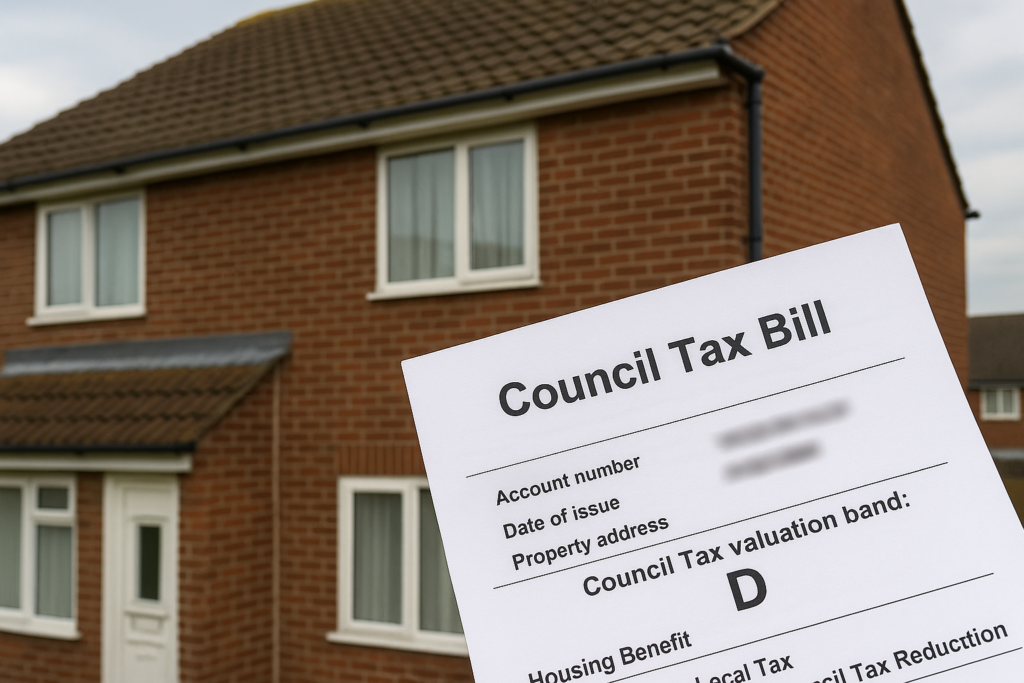
If your council tax band looks wrong, don’t just complain to the council and hope they “review it”. In the UK, the banding itself is usually controlled through the Valuation Office Agency (VOA) in England and Wales (and different bodies in Scotland/Northern Ireland). The fastest path is: check comparable properties, build a short evidence pack, and submit the right type of challenge.
This is a practical step-by-step guide for fixing a band that’s too high (or confirming yours is correct) without wasting weeks.
First: what “council tax band” actually is
Your council tax band is a valuation category based on your property (size, type, and comparable values). The important point: your council usually collects the money, but the banding decision is handled through the relevant valuation authority (VOA in England/Wales).
So if your band is wrong, you need to target the banding system — not just the bill.
Quick check: signs your council tax band might be wrong
- Properties on your street that look the same are in a lower band
- You’re in a flat converted building and similar flats are lower
- You’re paying more than neighbours in near-identical homes
- Your property has obvious disadvantages (traffic/noise/poor access) compared to nearby properties in the same band
- Your home was split/merged/altered and the band looks out of step with similar properties
What people usually get wrong
- They only ask the council. The council can’t always change the band — you must use the valuation route.
- They compare the wrong properties. You need close matches: same type, size, location, and condition.
- They send a long essay. A short evidence pack wins faster than a rant.
- They don’t consider risk. In rare cases, a review can reveal your band should be higher (more on this below).
Step-by-step fix (do this in order)
Step 1 — Find your band and compare it properly
Start by writing down:
- Your address
- Your current band
- Your property type (flat/terrace/semi/detached)
- Basic size indicators (bedrooms, floor area if known)
Then find 5–10 comparable properties very close to you (same street or nearby) that are genuinely similar. You’re looking for a pattern: if most near-identical properties are lower, that’s your signal.
Step 2 — Pick the best 3 “comparison properties” (quality beats quantity)
Choose three comps that are:
- as close as possible geographically
- same property type (flat vs house matters)
- similar size/layout
- same build era if possible
Make a simple table for yourself (you can paste into your notes):
- Your address — Band X
- Comp 1 — Band Y
- Comp 2 — Band Y
- Comp 3 — Band Y
If your three best comps are all lower, you have a clean argument.
Step 3 — Check whether you should “challenge” or “ask for review”
In England and Wales, the formal mechanism is usually a band challenge / proposal through the valuation authority route. The exact form and eligibility can depend on your circumstances (for example, moving into a property recently can create a challenge window in some situations).
If you’re outside typical windows, you can still raise concerns, but you need to be realistic: the system has rules about when formal challenges are accepted. Your best move is to submit a clear, evidence-based request through the official route and be prepared for it to be treated as an inquiry if you don’t meet formal criteria.
Step 4 — Write a short, effective challenge message (copy/paste)
Keep it short and factual. Use this structure:
Template:
“I believe my council tax band is too high for [Your Address]. My property is a [type] with [basic details]. Comparable properties nearby with the same/similar size and type are in a lower band: [Comp 1 address — band], [Comp 2 — band], [Comp 3 — band]. Please review the banding and confirm the outcome and timeline.”
That’s enough. You can attach a screenshot list of the comparable bands if you have it.
Step 5 — Submit through the correct route
Submit your request through the valuation authority process for your nation:
- England/Wales: VOA route is commonly used for banding challenges
- Scotland: banding is handled via the Scottish system (Assessor)
- Northern Ireland: domestic rating system is different (use the NI route)
The key idea: the band decision is not just a council billing issue. If you only contact the council, you often get bounced around.
Step 6 — Keep paying while it’s reviewed
Even if you’re confident the band is wrong, keep paying your council tax as normal. Band disputes can take time. Not paying can trigger enforcement, which is a different problem you don’t need.
What happens next (and how to respond)
If they agree and lower the band
You should see:
- updated band on the official record
- recalculated council tax bill
- potential backdating/refund depending on the decision
If they reject it
If rejected, don’t immediately re-submit the same thing. Instead:
- ask what comparisons they used and why yours were rejected
- check whether your comps genuinely match (flat vs house, size differences)
- find 2–3 better comps and escalate again with stronger matches
If they say you’re not eligible to formally challenge
This happens. The system has rules about formal challenge windows. Your best move is still to:
- keep your evidence pack
- ask what would make a challenge valid in your situation
- focus on building a strong set of comparable properties so you’re ready if circumstances change
Risk: can your band go up?
Yes, in rare cases a review can reveal your band should be higher. This is more likely if:
- your home is clearly larger/better than neighbours you’re comparing to
- you’re comparing across very different property types
- the local pattern suggests your band is already low
How you reduce risk: only challenge when you have strong comparables that are genuinely like-for-like and lower than yours.
FAQ (long-tail)
How do I know if my council tax band is wrong?
The strongest indicator is when multiple very similar nearby properties are in a lower band. One random lower band isn’t enough — a consistent pattern is.
Should I contact the council or the VOA?
The council collects payments, but banding is usually handled through the valuation authority route. Start with the correct banding route; otherwise you can waste time being redirected.
Can I get a refund if my band is reduced?
Often yes, depending on how the change is applied. If the band is reduced and backdated, the council should recalculate your bill and issue a credit/refund. Outcomes vary based on the decision.
How long does a council tax band review take?
It varies. The important part is having a clear submission with strong comparables, so it doesn’t get stuck in requests for more information.
What comparisons are “best” for a challenge?
The best comparisons are close by, same property type, similar size, similar layout, and broadly similar condition. Same street is ideal.
Final next step
Pick three strong comparable properties, send a short evidence-based request through the correct valuation route, and keep payments normal while it’s reviewed. Most successful challenges are won on simple comparables — not long arguments.
Want a quick “is my band wrong?” check?
Send your postcode (or street area) and property type, and we’ll tell you what to compare and what usually counts as strong evidence.
General UK guidance only. Not legal advice.



3 thoughts on “Council Tax Wrong Band — how to check and challenge (UK)”