Each step changes what evidence matters, what risks appear, and what outcomes remain realistic. This pillar maps that escalation system across six stages:
- Denial and dispute of responsibility
- Formal complaint and procedural leverage
- Harassment patterns and retaliatory behaviour
- Council inspection and enforcement reality
- Financial defence and arrears risk
- Tribunal and court routes
Scope is strictly active-tenancy escalation. End-of-tenancy deposit deductions, inventory disputes and post-move claims sit in a separate pillar because they follow different evidence rules and different failure points.
This framework primarily reflects statutory processes in England and Wales; procedural differences may apply in Scotland and Northern Ireland.
The Escalation Framework – Structural Escalation Model During an Active Tenancy
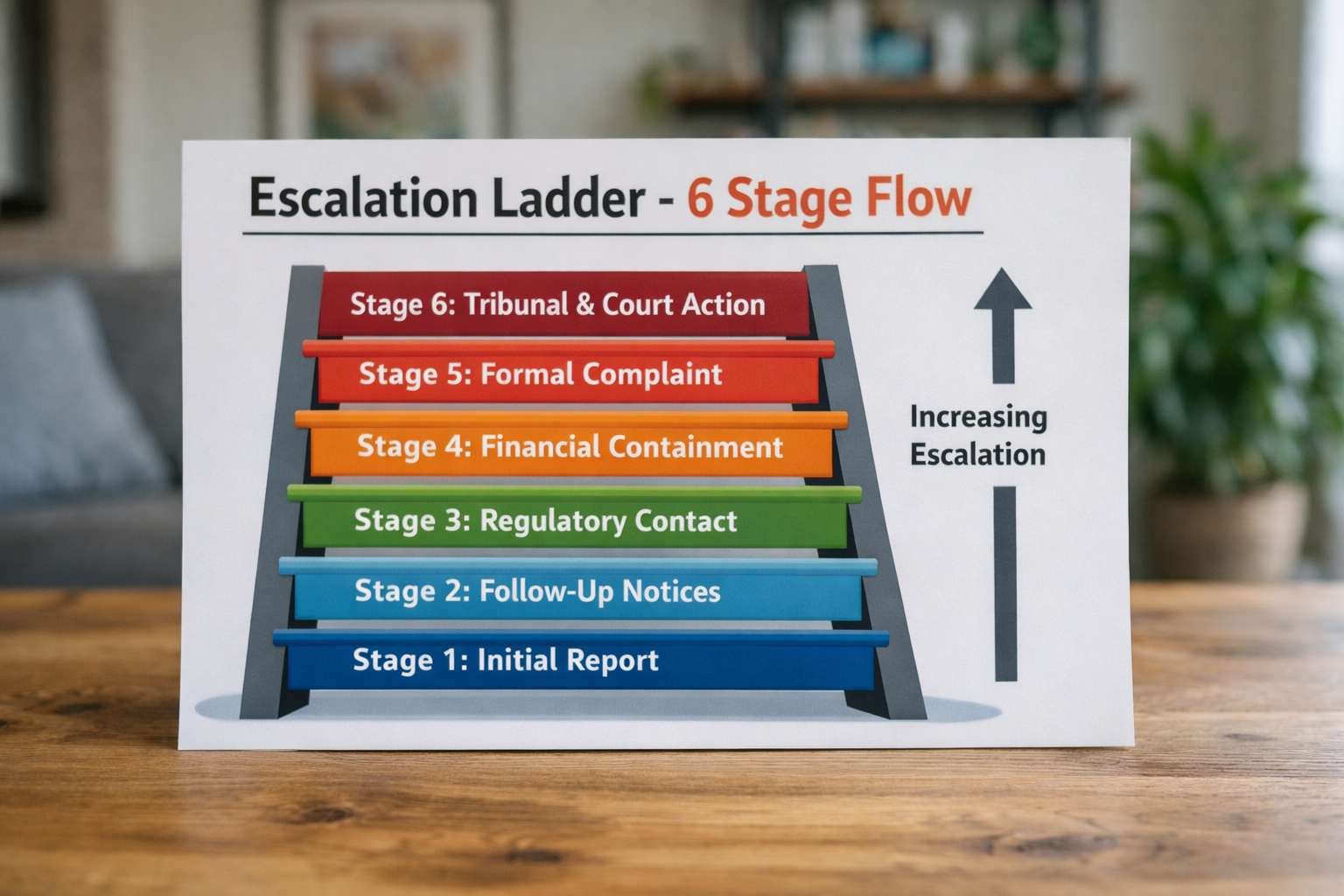
Escalation in housing disputes follows a predictable structural progression once responsibility is contested. The sequence below reflects how repair disputes typically evolve during an active tenancy. Each stage alters risk exposure, evidential requirements and legal positioning.
Escalation at a Glance
| Stage | Risk Level | Financial Risk | Possession Risk | Primary Objective |
|---|---|---|---|---|
| 1. Denial / Delay | Low–Moderate | Minimal | None | Establish documented timeline |
| 2. Formal Complaint | Moderate | Minimal | Low | Create procedural leverage |
| 3. Behavioural Escalation | Moderate–High | Indirect | Emerging | Document pattern and sequence |
| 4. Council Enforcement | High | Limited direct | Context-dependent | Trigger statutory assessment |
| 5. Financial Exposure | Very High | Significant | Active (Section 8 risk) | Stabilise rent position |
| 6. Tribunal / Court | Critical | Quantified claim | Parallel if possession ongoing | Obtain binding determination |
The Six-Stage Escalation Ladder
| Stage | Primary Trigger | What Changes Legally | Main Risk Introduced | Relevant Cluster Pages |
|---|---|---|---|---|
| 1. Denial / Delay | Repair ignored or disputed | Shift from maintenance issue to liability dispute | No structured evidence trail | Ignoring emails, Repair delays |
| 2. Formal Complaint | Repeated non-compliance | Creation of formal timeline and notice period | Vague complaint language | Heating dispute |
| 3. Behavioural Escalation | Access pressure, eviction threats, rent pressure | Potential retaliation narrative forms | Escalation into possession route | Eviction threats, Retaliatory pattern |
| 4. Council Enforcement | Health or safety threshold reached | Council inspection and statutory powers engaged | Enforcement delay or refusal | Council inspection, Council refusal |
| 5. Financial Exposure | Arrears or rent strategy change | Section 8 risk threshold engaged | Ground 8 mandatory possession risk | Withholding rent, Section 8 arrears |
| 6. Tribunal / Court | Regulatory plateau or financial claim | Formal adjudication route opened | Missed limitation deadlines | RRO rejected, Small claims |
Why Sequence Matters
The order of escalation determines how a dispute is interpreted later. If arrears appear before a structured complaint, the case becomes a rent default issue. If regulatory contact occurs before written notice, council may treat the issue as premature. If retaliation appears before inspection, motive becomes difficult to demonstrate.
Each stage modifies the evidential environment and procedural exposure.
- In Stage 1, documentary continuity is critical. Cases such as repairs that were completed but later failed and independent survey evidence contradicting the landlord’s position illustrate how liability disputes take shape.
- In Stage 4, regulatory thresholds matter. Council involvement, including delayed enforcement action, expired improvement notices or non-compliance with a served notice, does not guarantee immediate resolution.
- In Stage 5, financial exposure can override prior leverage, particularly in Section 8 arrears scenarios linked to disrepair. Improper rent decisions frequently collapse otherwise strong claims.
Structural Escalation vs Emotional Escalation
Emotional escalation is reactive. Structural escalation is chronological and evidence-based. Structural escalation preserves options. Emotional escalation reduces them.
The remainder of this pillar dissects each stage individually, analysing how responsibility disputes form, how behavioural pressure develops, how enforcement operates in practice, and how financial and tribunal routes alter the dispute landscape.
Stage 1 – Denial and Dispute of Responsibility
Most housing disputes do not begin with an explicit refusal to repair. They begin with reframing. The issue is minimised, redirected or reclassified. What was originally presented as a repair obligation becomes a disagreement about causation, urgency or tenant conduct.
This stage determines the future direction of the dispute. If responsibility is successfully reframed, later enforcement becomes harder because the dispute shifts from “failure to repair” to “uncertain liability”.
Common Reframing Patterns
- Silence and attrition:
Landlord ignoring emails and calls
illustrates how repeated non-response weakens momentum and fragments timelines. - Prolonged delay:
Repairs delayed for months
demonstrates how delay itself becomes a structural issue. - Reclassification of urgency:
No heating deemed non-emergency
shows how severity is downplayed to reduce compliance pressure. - Temporary or superficial fixes:
Repairs done but problem returned
reflects how partial work creates ambiguity about completion. - Blame shift to tenant behaviour:
Tenant blamed for ventilation despite structural issue
reframes structural defects as lifestyle problems. - Health impact denial:
Mould-related illness liability denied
shifts the dispute into evidential territory. - Competing expert narrative:
Independent survey contradicts landlord’s claim
demonstrates how technical disagreement escalates complexity.
How Liability Disputes Form
Liability disputes typically follow one of three pathways:
- Causation dispute – disagreement over whether the defect arises from structure, wear and tear, or tenant conduct.
- Severity dispute – disagreement over whether the issue meets a repair threshold or constitutes a health and safety concern.
- Completion dispute – disagreement over whether works have resolved the issue.
At this stage, the dispute shifts from operational (fix the defect) to evidential (prove responsibility). Once that shift occurs, documentation becomes central.
Structural Evidence Requirements
Liability disputes are rarely decided by single photographs or isolated messages. They are assessed through continuity:
- Chronology of reporting and response.
- Consistency of description across time.
- Visible progression or recurrence of the issue.
- Independent corroboration where available.
Where technical disagreement exists, such as in the independent survey contradiction scenario, the dispute ceases to be about willingness and becomes about technical interpretation. That increases cost and delay risk.
Delay as Structural Risk
Delay is not neutral. Extended inaction can alter habitability conditions, increase secondary damage and create financial exposure. The page repairs delayed for months demonstrates how prolonged delay becomes part of the liability argument itself.
When delay combines with blame shift, the dispute hardens. Once hardened, informal resolution probability declines sharply.
Transition Point to Formal Escalation
Stage 1 ends when either:
- Responsibility remains denied after documented notice; or
- Health or safety impact becomes credible; or
- Behavioural pressure begins to replace engagement.
At that point, the dispute moves into procedural territory. The next stage focuses not on argument, but on leverage.
Stage 2 – Formal Complaint and Procedural Leverage
When denial or delay stabilises into a pattern, informal communication loses strategic value. At this point the dispute must move from conversational exchange to procedural positioning. The function of a formal complaint is not rhetorical persuasion. It is structural anchoring.
A properly structured complaint converts an ongoing issue into a dated record. That record later determines how council, tribunal or court interpret sequence, knowledge and opportunity to remedy.
What Changes at the Formal Complaint Stage
Informal messages often contain fragmented facts, emotional tone or shifting descriptions.
A formal complaint consolidates:
- Clear identification of the defect.
- Reference to previous notifications.
- Defined remedy sought.
- Reasonable compliance timeframe.
- Statement that further action may follow if unresolved.
Without this consolidation, later enforcement becomes vulnerable to the argument that the landlord was not given a clear opportunity to remedy.
Link Between Denial and Formal Escalation
Stage 1 disputes such as:
often collapse into ambiguity. A formal complaint freezes that ambiguity into a specific statement.
It removes flexibility from both narratives.
Procedural Leverage
Leverage at this stage is not enforcement power. It is sequencing power.
By establishing documented notice and a response window, the escalation timeline becomes measurable.
This sequencing becomes critical if the matter progresses toward:
Regulatory bodies and courts examine chronology closely. The presence of a structured complaint with defined timeframes often determines whether later escalation appears proportionate or premature.
Common Structural Failures
- Vague or undefined compliance periods.
- Multiple unrelated complaints merged into one message.
- Absence of reference to prior notice.
- Switching tone between cooperative and hostile language.
These failures weaken procedural credibility and increase the likelihood that enforcement bodies treat the dispute as interpersonal rather than structural.
Transition to Regulatory Stage
Stage 2 concludes when either:
- No substantive response is received within the stated timeframe.
- Liability continues to be denied without investigation.
- The issue reaches health or safety significance.
At that point, the dispute exits bilateral territory and enters regulatory exposure. The next stage examines how council intervention functions in practice, including inspection limits and enforcement delay realities.
Stage 3 – Harassment, Access Abuse and Retaliatory Behaviour
Once a dispute becomes formal, behaviour frequently shifts. Communication may become more frequent, more urgent or more confrontational. Access requests increase. Inspection visits multiply. Eviction language begins to appear. At this stage the dispute is no longer limited to repair liability. It becomes a behavioural and procedural risk assessment.
Not every change in tone or frequency constitutes harassment. The legal distinction depends on pattern, timing and proportionality. A single request for access is routine. Repeated short-notice demands following a complaint
may signal escalation.
Access Pressure Patterns
In these scenarios, the central issue is not the existence of access rights, but frequency, justification and correlation with prior escalation steps.
| Behaviour | Neutral Interpretation | Escalation Risk |
|---|---|---|
| Repeated access requests | Ongoing repair coordination | Pressure tactic if unrelated to actual works |
| Short-notice visits | Urgency claim | Intimidation if pattern continues |
| Unscheduled attendance | Miscommunication | Potential unlawful entry risk |
Eviction Pressure and Retaliatory Signals
- Landlord threatening eviction
- Retaliatory eviction threat after repair request
- Rent increase proposed after reporting problems
- Section 21 issued after disrepair complaint
Retaliatory behaviour is rarely explicit. It appears as sequence.
Complaint → Delay → Council contact → Sudden possession language. The evidential strength lies in chronology.
Behavioural Escalation vs Legal Escalation
Behavioural escalation often precedes legal escalation. Increased pressure may be intended to discourage regulatory involvement or accelerate voluntary departure.
However, escalation into eviction routes introduces new procedural complexity. Once possession action begins, the dispute intersects with housing court timelines, and financial exposure may increase.
Risk Interaction with Financial Stage
Behavioural pressure frequently coincides with financial triggers.
For example:
- Increased access demands followed by arrears allegation:
Section 8 citing arrears caused by disrepair - Rent increase during active complaint:
Rent increase after complaint
These intersections transform a repair dispute into a possession risk scenario.
Pattern Recognition
Isolated incidents rarely determine outcome. Courts and tribunals evaluate:
- Timing relative to formal complaint.
- Consistency of behaviour.
- Disproportionate reaction to regulatory contact.
- Sudden procedural acceleration.
When behavioural escalation emerges, the dispute has moved beyond repair logistics.
It now involves risk management across enforcement, financial exposure and potential possession action.
The next stage analyses regulatory involvement and the practical limits of council enforcement.
Stage 4 – Council Enforcement and Statutory Powers
Regulatory involvement marks a structural turning point. Once a local authority is contacted, the dispute shifts from bilateral negotiation to statutory assessment. However, inspection does not equal enforcement, and enforcement does not equal immediate compliance.
Council intervention operates within resource limits, evidential thresholds and internal prioritisation. Understanding these constraints is essential to avoid unrealistic expectations or premature legal moves.
Inspection as Evidence, Not Resolution
The initial regulatory step typically involves inspection:
Council inspection for rental property
An inspection records conditions and assesses risk using statutory frameworks. It does not guarantee immediate works, nor does it automatically impose penalties.
| Regulatory Step | What It Does | What It Does Not Do |
|---|---|---|
| Inspection | Documents hazards and condition | Compel instant repair |
| Informal Advice | Encourages voluntary compliance | Create binding obligation |
| Improvement Notice | Impose statutory repair deadline | Guarantee physical completion |
| Prosecution / Civil Penalty | Penalise non-compliance | Directly compensate tenant |
Refusal or Delay by the Council
Regulatory systems are not uniform. Some authorities decline involvement where threshold criteria are not met:
Council refuses to act due to private tenancy
Others may experience prolonged processing times:
Council delays enforcement notice for months
Delay alters leverage. If enforcement action stalls, behavioural pressure and financial risk may continue unchecked. The dispute then requires parallel risk management rather than reliance on regulatory momentum.
Improvement Notices and Compliance Failure
Where statutory hazards are identified, an improvement notice may be served. However, notices sometimes expire without effective compliance:
Failure to comply with a notice increases potential regulatory exposure for the landlord, but it does not automatically produce compensation or repair completion.
Limits of Regulatory Leverage
Council enforcement serves public safety objectives. It is not designed primarily as a compensation mechanism. Where disputes involve financial recovery or specific performance beyond regulatory scope, tribunal or court routes may still be required.
Additionally, enforcement timing may intersect with possession routes. If eviction proceedings begin during regulatory involvement, procedural complexity increases.
When Regulatory Pathways Plateau
Regulatory plateau occurs when:
- Inspection confirms issues but enforcement is delayed.
- Notice is served but compliance remains partial.
- Authority declines escalation beyond advisory stage.
At plateau, the dispute transitions from regulatory reliance to strategic decision-making. Financial exposure, arrears risk and tribunal options become central.
The next stage examines how financial decisions during escalation can either preserve or destroy an otherwise strong procedural position.
Stage 5 – Financial Defence and Risk Management
Financial exposure is the most common turning point in an escalating housing dispute. Once arrears appear or rent strategy changes, the dispute stops being purely about repair or compliance. It becomes a possession-risk assessment.
Many otherwise strong disrepair cases collapse at this stage because financial decisions are taken reactively rather than structurally. The introduction of arrears, even where linked to unresolved defects, can shift the legal centre of gravity.
Withholding Rent – Structural Risk
The question of withholding rent is frequently raised in ongoing disputes:
Withholding rent – when it’s allowed.
Withholding without strict procedural alignment can activate possession routes. Even where disrepair exists, rent arrears introduce mandatory grounds risk under certain thresholds.
The structural problem is sequencing:
- If arrears arise before documented formal complaint, the dispute is framed as non-payment.
- If arrears exceed statutory thresholds, discretionary arguments weaken.
- If arrears accumulate during regulatory delay, leverage shifts toward possession.
Section 8 Exposure
Where arrears develop, landlords may initiate possession proceedings:
Section 8 citing rent arrears caused by disrepair.
Even if arrears are factually linked to unresolved defects,the presence of a notice changes the procedural environment.
The dispute becomes dual-track: disrepair and possession defence.
| Financial Scenario | Immediate Effect | Long-Term Risk |
|---|---|---|
| Short-term arrears below threshold | Negotiation pressure | Escalation if unresolved |
| Arrears above mandatory ground threshold | Possession risk | Reduced discretionary protection |
| Partial payment pattern | Ambiguous compliance | Credibility dispute in court |
Rent Increase During Escalation
Financial pressure may also appear in the form of proposed rent increases:
Rent increase proposed after reporting problems.
While legality depends on compliance with statutory requirements, timing relative to complaint may influence how escalation is interpreted.
Unlawful or Disputed Charges
Financial disputes often expand beyond rent itself:
The presence of disputed charges complicates financial accounting. In shared tenancies, liability allocation can distort arrears calculations, increasing procedural complexity.
Financial Strategy vs Emotional Reaction
Financial escalation is irreversible in ways that repair disputes are not. Once possession proceedings begin, reversing momentum requires structured defence.
The key distinction at this stage is between controlled exposure and uncontrolled arrears. Controlled exposure remains aligned with documented complaint chronology. Uncontrolled arrears override prior leverage.
Transition to Tribunal or Court
When financial disputes combine with unresolved defects and regulatory plateau, the escalation ladder reaches adjudication territory.
The next stage examines tribunal routes, Rent Repayment Orders and small claims litigation, including procedural pitfalls that frequently undermine escalation outcomes.
Stage 6 – Tribunal, Rent Repayment Orders and Court Action
When bilateral negotiation, regulatory contact and financial containment fail to resolve the dispute, escalation enters adjudicative territory. At this stage the issue is no longer compliance. It is determination.
Adjudication routes differ in purpose, threshold and outcome. Choosing incorrectly can result in delay, rejection or procedural collapse.
Rent Repayment Orders (RRO)
Rent Repayment Orders are tribunal-based mechanisms that may apply in specific statutory breach scenarios. However, procedural precision is critical.
Rejection commonly results from evidential gaps, incorrect statutory framing or failure to observe limitation periods.
| RRO Feature | Strength | Limitation |
|---|---|---|
| Tribunal-based | Lower cost than court | Restricted to specific breaches |
| Rent-focused remedy | Potential financial recovery | No direct repair order |
| Defined eligibility | Clear statutory framework | Strict procedural compliance required |
Small Claims Court
Monetary disputes not suitable for RRO may proceed through the county court system:
Small claims court process
Court proceedings introduce formal pleadings, evidence bundles and hearing timelines. Unlike regulatory enforcement, court action centres on loss, breach and remedy.
Comparative Escalation Routes
| Route | Primary Function | Best Used When | Common Failure Point |
|---|---|---|---|
| Council Enforcement | Hazard mitigation | Health and safety threshold met | Delay or limited follow-up |
| RRO (Tribunal) | Rent recovery | Qualifying statutory breach | Application rejected |
| Small Claims Court | Monetary compensation | Quantifiable loss exists | Insufficient evidence or pleading errors |
Interaction With Ongoing Tenancy
Litigation during an active tenancy alters relational dynamics. Communication typically becomes formalised. Settlement probability may decrease. Financial exposure can expand if costs are awarded.
Where possession proceedings run concurrently with disrepair claims, procedural complexity increases significantly.
When Escalation Becomes Determination
The transition from enforcement to adjudication represents a structural break. At this point the dispute is no longer about encouraging compliance. It is about obtaining a decision.
The effectiveness of this stage depends almost entirely on the strength of documentation built across Stages 1–5.
Strategic Errors That Undermine Otherwise Strong Cases
A significant number of housing disputes do not fail because the underlying issue lacks merit. They fail because escalation is mishandled. Procedural strength built during early stages can be neutralised by later inconsistency, overreach or financial miscalculation.
1. Fragmented Documentation
Disputes that involve repeated delay or denial — such as repairs delayed for months or repairs done but problem returned — require continuity. When evidence is scattered across informal messages,
screenshots without timestamps or undocumented conversations, credibility weakens.
Adjudicators assess sequence, not sentiment. Gaps in chronology invite reinterpretation.
2. Escalation Without Sequencing
Contacting council before issuing a structured complaint, or initiating court action without regulatory context, can create the appearance of premature escalation.
For example, disputes such as council refusal to act often reveal that procedural groundwork was incomplete.
3. Emotional Financial Decisions
The most damaging structural error involves rent strategy. Improper withholding — addressed in withholding rent – when it’s allowed — can convert a disrepair dispute into a possession case.
Once a Section 8 notice is engaged, defensive complexity increases dramatically.
4. Overextension of Legal Claims
Attempting simultaneous routes without clear statutory basis — for example combining regulatory complaints, RRO applications and small claims without procedural alignment — frequently results in rejection.
Pages such as RRO application rejected and missed RRO deadline demonstrate how technical errors erase leverage.
5. Behavioural Escalation That Undermines Credibility
When disputes enter harassment territory — including scenarios described in access pressure cases or retaliatory patterns — reactive communication can distort the narrative.
Aggressive messaging, inconsistent statements or informal settlement demands weaken structural positioning.
6. Ignoring Limitation and Timing
Many adjudicative failures stem from missed deadlines rather than weak substance. Tribunal and court routes operate within strict timeframes. Failure to monitor those timeframes converts viable claims into closed routes.
Escalation succeeds when it is chronological, proportionate and documented. It fails when it becomes reactive, inconsistent or financially unstable.
When Escalation Should Pause
Escalation is not inherently beneficial. In some circumstances, accelerating toward regulatory or court routes may reduce leverage rather than strengthen it.
Pause may be appropriate where the landlord has initiated substantive remedial action, where inspection is scheduled within a defined timeframe, or where financial exposure is close to possession thresholds. Escalating during transitional compliance can create procedural conflict rather than resolution.
A structured pause does not mean abandoning the dispute. It means preserving chronological clarity, stabilising financial position, and allowing documented deadlines to mature before triggering the next escalation stage.
Quick FAQ – High-Intent Escalation Questions
Can a landlord evict during a repair dispute?
Eviction action can be initiated during an ongoing dispute. Whether it succeeds depends on notice type, statutory compliance and financial position. Where arrears are involved, see Section 8 citing rent arrears caused by disrepair
Does council involvement prevent eviction?
Council inspection does not automatically block possession proceedings.
It may influence timing or procedural interpretation, but it is not a blanket shield.
See council inspection process
Is it legal to stop paying rent if repairs are ignored?
Rent strategy carries significant risk. Improper withholding can activate possession grounds.
Structural limitations are outlined in withholding rent – when it’s allowed
What if the landlord says the problem is my fault?
Liability disputes commonly involve blame shift.
Relevant examples include ventilation blame disputes and independent survey contradictions
What happens if the council delays enforcement?
Regulatory delay does not eliminate landlord obligations, but it reduces immediate leverage.
See council delays enforcement notice
Can compensation be claimed while still living in the property?
Financial recovery routes may remain open during an active tenancy, depending on loss and statutory framework. Tribunal or court routes are outlined in small claims court process
What if an improvement notice expires with no action?
Expired notices increase regulatory exposure but do not automatically resolve the dispute.
See improvement notice expired without action
Can access demands count as harassment?
Pattern and proportionality determine classification. Relevant scenarios are examined in repeated access pressure cases
What if a Rent Repayment Order application is rejected?
Rejection often stems from procedural error or ineligible grounds.
See RRO application rejected
Does reporting the landlord increase risk of retaliation?
Behavioural escalation sometimes follows regulatory contact.
Chronology determines how retaliation is interpreted.
See retaliatory eviction patterns
Heavy FAQ – Procedural and Scenario-Based Escalation Analysis
What if a Section 8 notice is served while disrepair remains unresolved?
When a Section 8 notice citing rent arrears caused by disrepairis served during an ongoing repair dispute, the case becomes dual-track. The court assesses rent arrears under statutory thresholds, while the disrepair narrative must be structured as a defence or counterclaim. The outcome depends on arrears level at hearing date, documented notice chronology, and evidence linking arrears directly to unresolved defects.
What if the council confirms hazards but takes no enforcement action?
Inspection confirmation without enforcement does not invalidate the complaint.
However, where council delays enforcement notice or council refuses to act reliance on regulatory pressure alone becomes ineffective. At that stage, evidential value of inspection findings may support tribunal or court routes.
Can a landlord issue a Section 21 after a repair complaint?
Timing matters. Where a possession notice follows documented complaint or regulatory contact,
sequence becomes relevant. In cases such as Section 21 issued after disrepair complaint courts evaluate statutory compliance and procedural validity rather than motive alone.
What if access is repeatedly demanded during escalation?
Persistent access demands following complaint or council involvement — as described in repeated access after complaint must be analysed by frequency, notice period and relation to actual works. If access becomes disproportionate, behavioural escalation may form part of a broader dispute pattern.
What if repairs are attempted but defects reappear?
Recurrence shifts the issue from delay to adequacy. In repairs done but problem returned the evidential focus moves to durability and technical sufficiency. Multiple failed attempts can strengthen liability arguments if documented sequentially.
How do independent surveys affect escalation?
Where technical disagreement exists — see independent survey contradicts landlord’s claim — the dispute may transition into expert interpretation territory. Survey evidence can support tribunal claims but increases procedural complexity and cost exposure.
What if an improvement notice expires without compliance?
An improvement notice expired without action increases regulatory exposure but does not automatically produce repair completion. Continued non-compliance may support escalation into penalty or tribunal proceedings, depending on statutory route.
Can rent increases during a dispute be challenged?
In scenarios such as rent increase proposed after reporting problems egality depends on compliance with statutory process.
Timing relative to complaint may influence interpretation but does not automatically invalidate the increase.
What if a Rent Repayment Order application fails?
Where an RRO application is rejected or deadline is missed alternative court routes may remain available. Procedural failure does not always eliminate substantive claim, but it narrows available forums.
Does ongoing tenancy weaken compensation prospects?
Active occupation does not prevent adjudication. However, litigation during tenancy may affect relationship dynamics and financial exposure. Routes such as small claims court operate independently of tenancy status, provided limitation periods are observed.
Escalation succeeds when chronology, financial position and regulatory context align It fails when sequencing collapses or deadlines are ignored. Every adjudicative route ultimately depends on the structural integrity
established in earlier stages.
Before You Move On – Escalation Checkpoint
Escalation is rarely undone once financial or possession routes are triggered. Before progressing beyond this point, structural alignment should be reviewed.
Chronology Integrity
Confirm that the dispute timeline is coherent:
- Initial defect reporting is dated and preserved.
- Follow-up communication is sequential and consistent.
- Formal complaint contains a defined compliance period.
- Regulatory contact, if any, follows documented notice.
Where earlier stages resemble scenarios such as ignored communication or prolonged repair delay, discontinuity in documentation weakens adjudicative strength.
Financial Exposure Position
Review rent status before entering tribunal or court pathways:
- No uncontrolled arrears accumulation.
- No contradictory payment patterns.
- No informal offsets without procedural grounding.
Financial instability interacts directly with Section 8 possession risk and can override earlier disrepair leverage.
Regulatory Plateau Assessment
If council involvement has occurred, assess whether enforcement has progressed or stalled:
Regulatory plateau does not invalidate the dispute. It signals that adjudicative routes may be the remaining escalation step.
Route Selection Clarity
Before initiating adjudication, ensure route alignment:
- Statutory breach suitable for
Rent Repayment Order - Quantifiable loss suitable for
small claims court
Parallel claims without statutory alignment increase rejection risk.
Escalation Threshold
Proceeding beyond this point means entering formal adjudication or structured possession defence.
Once initiated, withdrawal may involve cost, reputational friction and financial exposure.
Escalation should occur because the procedural ladder has been climbed sequentially,
not because frustration has peaked.