Housing Problems in the UK – Where Do You Start?
If you are dealing with a housing problem in England, the most important step is identifying what type of dispute you are facing. Private tenancy law operates through structured routes. The correct starting point depends entirely on your situation.
- A tenant facing eviction – read the section on Section 21 or Section 8 possession below.
- A tenant with serious repair issues – go to Landlord Repair Obligations.
- A landlord dealing with rent arrears – review the Section 8 arrears framework.
- Disputing a tenancy deposit – see Tenancy Deposit Disputes.
- Challenging a rent increase – go to Rent Increase Disputes.
Each section below explains not just your rights, but what the court or tribunal will actually examine. Housing disputes are decided by compliance and evidence, not by frustration or assumption.
Common Housing & Tenancy Problems in England
Private renting disputes in England typically fall into one of the following categories:
- Deposit not returned after tenancy
- Landlord ignoring repairs
- Section 21 eviction notice
- Section 8 eviction for rent arrears
- Rent increase disputes
- Damp and mould issues
- Landlord entering without notice
- Council improvement notices
- Bailiff eviction process
- Rent repayment orders
This guide connects these issues into one system. They are rarely isolated. A repair dispute can affect eviction. Deposit compliance can affect possession validity. Rent arrears can override emotional arguments. Understanding how these elements interact is essential.
The Legal Framework Governing Private Renting in England
Private tenancy disputes are not governed by a single rule. They operate within a statutory framework that has developed over decades. The most relevant legislation includes:
- Housing Act 1988 – establishes assured shorthold tenancies and the Section 21 and Section 8 possession routes.
- Landlord and Tenant Act 1985 – sets out repair obligations and standards of habitability.
- Housing Act 2004 – introduces tenancy deposit protection and local authority enforcement powers.
- Deregulation Act 2015 – strengthens compliance requirements for Section 21 and clarifies retaliatory eviction rules.
Courts interpret disputes within this statutory architecture. Contractual clauses in tenancy agreements cannot override mandatory statutory protections.
Understanding which Act governs your issue determines which arguments are relevant and which are not.
The UK Fix Guide Housing Dispute Lifecycle (5 Stages)
Every housing dispute in England follows a recognisable structural path. Recognising this lifecycle early prevents reactive mistakes.
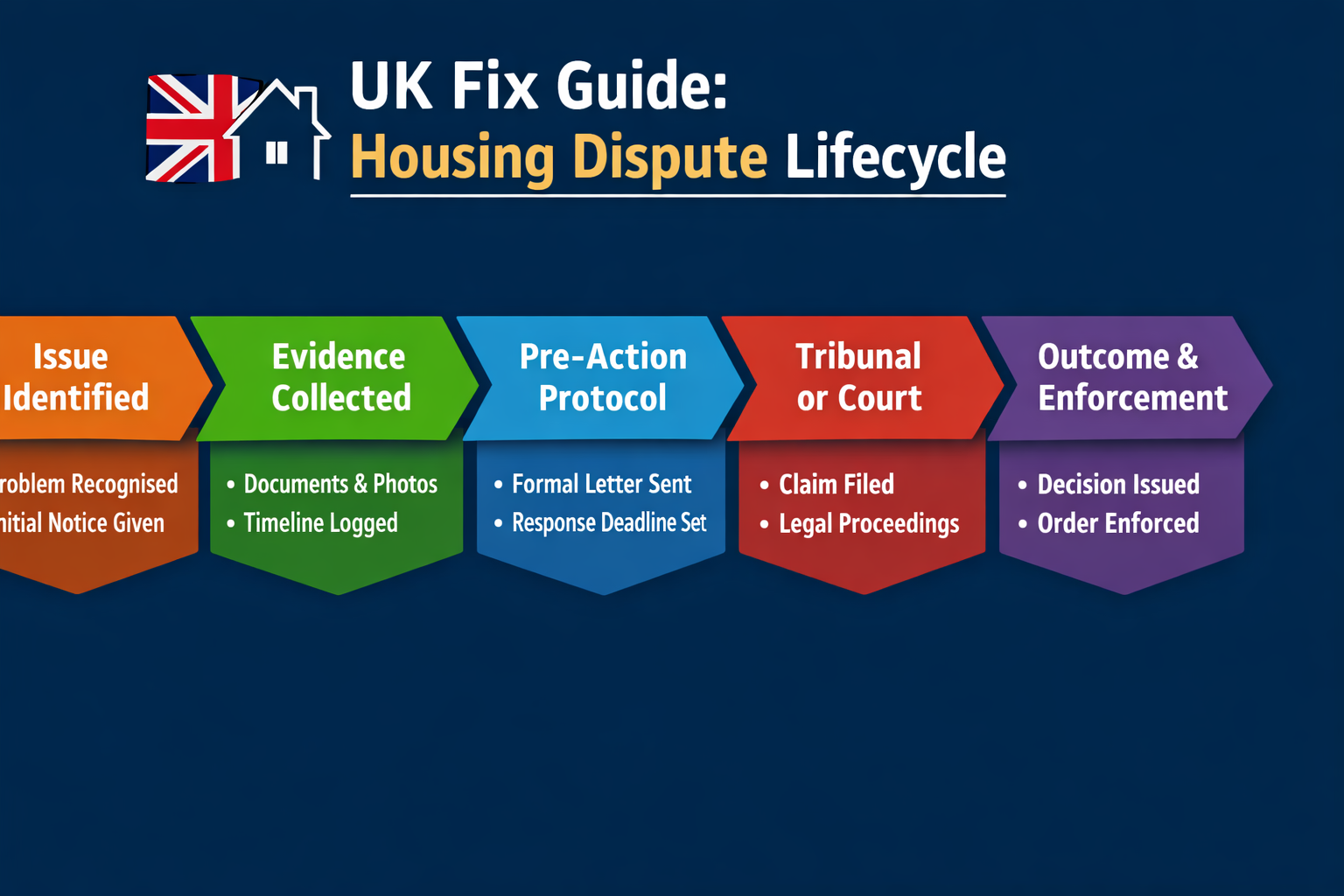
| Stage | What Happens | Critical Risk | What Creates Leverage |
|---|---|---|---|
| 1. Trigger | Problem emerges (repair, arrears, notice, deposit) | Informal reaction | Immediate written documentation |
| 2. Formal Notice | Complaint or statutory notice served | Incorrect wording or dates | Clarity and compliance |
| 3. Compliance Audit | Statutory requirements reviewed | Overlooking technical defect | Detailed procedural check |
| 4. Forum Selection | Tribunal or Court chosen | Escalating incorrectly | Jurisdiction accuracy |
| 5. Enforcement or Settlement | Order executed or agreement reached | Failure to follow through | Chronology and persistence |
Most housing disputes are lost at Stage 1 or Stage 3. Either the issue was never documented properly, or statutory compliance was never audited before escalation.
The sections below apply this lifecycle model to each major dispute type in England.
Tenancy Deposit Disputes in England – What Landlords and Tenants Must Prove
Tenancy deposit disputes are among the most common housing conflicts in England. They are also one of the most misunderstood. A deposit dispute is not decided on fairness alone. It is decided on evidence, statutory compliance and proportionality.
When a tenancy ends, the deposit must either be returned or formally disputed. If the parties cannot agree, the matter is usually resolved through the relevant tenancy deposit scheme’s adjudication process. That process is document-based. There is no oral hearing. There is no negotiation room. The adjudicator decides based on written evidence alone.
Understanding what must be proven – and by whom – is decisive.
Can a landlord keep your full deposit?
A landlord cannot automatically keep a deposit simply because damage is alleged. The burden generally falls on the landlord to demonstrate three things:
- The property was in a clearly defined condition at the start of the tenancy.
- The condition at the end represents deterioration beyond fair wear and tear.
- The amount claimed reflects genuine loss and not betterment.
If the landlord cannot prove the starting condition with credible evidence, deductions frequently fail. A tenant does not need to prove perfection. The landlord must prove loss.
The strongest foundation for any deposit claim is a detailed, signed check-in inventory supported by dated photographs. Without that baseline, adjudicators often conclude that the evidential burden has not been satisfied.
What counts as fair wear and tear?
Fair wear and tear refers to the natural deterioration that occurs through ordinary use over time. It is not a fixed rule; it depends on context.
Factors typically considered include:
- Length of the tenancy.
- Number of occupants.
- Age and quality of fixtures at the start.
- Expected lifespan of materials.
A short tenancy of six months creates different expectations than a tenancy lasting five years. A carpet that was already four years old at check-in cannot reasonably be replaced at full cost after a long tenancy unless clear, negligent damage is proven.
| Item | Short Tenancy | Long Tenancy (5+ Years) |
|---|---|---|
| Paintwork | Minor marks may justify limited deduction | Repainting often treated as landlord maintenance |
| Carpet | Significant new damage may justify repair | General flattening and fading expected |
| Appliances | Negligent damage may justify cost | Age significantly reduces recoverable amount |
The principle of betterment applies. A landlord cannot use the deposit to upgrade the property beyond its previous condition.
What happens if the deposit was not protected?
Deposit protection is not optional. Under statutory requirements, landlords must protect deposits within prescribed time limits and provide specific information to the tenant.
If this was not done correctly, two consequences may follow:
- The tenant may bring a financial penalty claim through the County Court.
- The landlord may face restrictions when attempting to use certain possession routes.
Deposit compliance therefore affects more than repayment. It can influence eviction validity.
Step-by-step process for challenging non-return:
Tenancy Deposit Not Returned After 10 Days.
How long does a landlord have to return a deposit?
Once a tenancy ends and agreement on deductions is reached, the deposit should be returned promptly. If there is disagreement, the dispute resolution process within the deposit scheme must be initiated within the relevant procedural framework.
Delays without communication create risk for the landlord. For tenants, failing to respond within evidence submission deadlines can weaken a challenge.
Evidence That Wins Deposit Disputes
Successful deposit disputes are built on documentation:
- Signed tenancy agreement.
- Signed check-in inventory.
- Dated photographs at check-in and check-out.
- Professional cleaning invoices (if relevant).
- Repair quotes showing proportional cost.
Assertions unsupported by documentary evidence rarely succeed in adjudication.
Deposit disputes may appear minor compared to eviction, but they often reveal deeper compliance issues. A failure to protect a deposit properly can influence later possession claims. What appears isolated can become structurally significant.
Landlord Repair Obligations in England – Legal Duties Explained
Repair disputes are one of the most frequent sources of tension in the private rented sector. They also expose a common misunderstanding: not every inconvenience is a legal breach, and not every delay is unlawful. At the same time, certain failures are serious and carry regulatory consequences.
Landlord repair duties arise from statutory obligations and cannot be contracted out of in a tenancy agreement. Courts assess repair disputes through a reasonableness test grounded in evidence and chronology.
How quickly must a landlord fix repairs?
There is no universal number of days that applies to every defect. The expected timeframe depends on severity and risk.
- Minor issues (loose fittings, minor leaks) – reasonable time for inspection and contractor arrangement.
- Urgent issues (loss of heating in winter, water supply failure) – faster response expected.
- Serious hazards (electrical safety, structural risk) – immediate attention required.
The legal responsibility generally begins when the landlord is informed of the defect. Written notice creates the strongest evidential record. Verbal complaints without confirmation may be difficult to prove later.
Escalation steps explained in detail:
Landlord Ignoring Repairs – Escalation Steps.
What counts as emergency repairs?
Emergency repairs typically involve issues that pose immediate risk to health, safety or essential services. Examples include:
- Total heating failure during winter months.
- Loss of water supply.
- Severe leaks causing structural damage.
- Electrical hazards.
- Broken external doors or windows compromising security.
In such cases, delay may be judged more strictly. Courts examine whether reasonable steps were taken promptly.
Emergency repair rights:
Emergency Repairs – Tenant Rights
Is the landlord responsible for damp and mould?
Damp and mould disputes are often complex because responsibility depends on cause. Structural issues, ventilation problems and condensation patterns are assessed differently.
Courts examine:
- Inspection reports.
- Photographic evidence.
- History of complaints.
- Whether reasonable remedial steps were taken.
Generalised blame rarely succeeds. The issue turns on evidence.
Detailed breakdown:
Damp and Mould – Landlord Responsibility.
Can you withhold rent for repairs?
Withholding rent without structured legal advice carries significant risk. Even if repair complaints are justified, unpaid rent may trigger Section 8 possession proceedings if statutory thresholds are met.
Courts treat rent arrears and disrepair as separate structural issues. Arrears are calculated numerically. Disrepair must be evidenced and quantified independently.
Before considering financial action, tenants should:
- Provide written notice of defects.
- Allow reasonable time for response.
- Consider regulatory escalation if serious.
Reactive withholding often weakens rather than strengthens position.
What if the landlord says contractors are unavailable?
Delays attributed to contractor availability are assessed through reasonableness. Courts will examine whether:
- The landlord attempted to arrange access promptly.
- Alternative contractors were considered.
- Temporary measures were offered where possible.
Simply stating that contractors are busy is not always sufficient. Documentation of attempts matters.
Further explanation:
Landlord Delays Repairs Citing Contractor Issues.
When does the council become involved?
Where serious hazards persist, tenants may contact the local authority. Environmental health officers can inspect and, if necessary, issue formal improvement notices requiring remedial works within defined timeframes.
An improvement notice strengthens evidential position but does not automatically cancel rent obligations or possession routes. Its effect depends on timing and statutory interaction.
Repair disputes illustrate a consistent principle: documentation and chronology determine outcome. The earlier and clearer the written record, the stronger the position if escalation becomes necessary.
Section 21 Eviction in England – Validity, Process and Defences
Section 21 is the most commonly used route for recovering possession of an assured shorthold tenancy in England. It is often described as a “no-fault eviction”. That phrase is misleading. While the landlord does not need to prove breach of contract, strict statutory compliance is required. If compliance fails, the possession claim fails.
Section 21 disputes are rarely about personal behaviour. They are about documentation, dates and statutory conditions.
What makes a Section 21 notice invalid?
A Section 21 notice may be invalid if mandatory requirements have not been satisfied. Common defects include:
- Deposit not protected within statutory timeframe.
- Failure to serve prescribed deposit information.
- Incorrect statutory notice form used.
- Miscalculation of the notice period.
- Failure to prove service of the notice.
- Service of the notice while a disqualifying improvement notice is in force.
Courts do not overlook technical errors. If a defect is identified, the claim may be dismissed and the landlord required to restart the process.
Detailed guidance:
Section 21 Notice – What To Do.
How long does Section 21 eviction take?
The Section 21 process follows defined stages:
- Service of a valid notice with statutory notice period.
- Issue of possession claim after notice expiry.
- Court review of compliance and any defence filed.
- Possession order granted if requirements satisfied.
- Bailiff enforcement if the tenant does not leave voluntarily.
Delays frequently arise from defective paperwork or compliance disputes. If a tenant raises arguable statutory defects, the court may list a hearing rather than determine the claim on paper.
The expiry of a notice does not end the tenancy. Only a possession order, and if necessary bailiff enforcement, ends occupation lawfully.
Can a landlord evict you for complaining about repairs?
If a tenant has made formal complaints about serious disrepair and the local authority has served an improvement notice, the landlord may face restrictions on using Section 21. This is often referred to as protection against retaliatory eviction.
The key issue is chronology. Courts examine whether:
- A legitimate complaint was made in writing.
- The landlord failed to respond appropriately.
- A relevant improvement notice was served.
If statutory conditions are met, the Section 21 route may be barred until compliance issues are resolved.
What happens after a possession order is granted?
If the court grants a possession order and the tenant remains in the property beyond the specified date, the landlord must apply for a warrant of possession. Bailiffs are then authorised to enforce the order.
Until enforcement occurs, the tenancy remains legally in effect. Self-help eviction is unlawful even after a possession order if enforcement has not been executed by authorised officers.
Defending a Section 21 Claim
A defence to a Section 21 claim generally focuses on compliance defects. Tenants should examine:
- Deposit protection timing.
- Accuracy of prescribed information.
- Validity of notice form.
- Calculation of notice expiry date.
- Evidence of service.
Ignoring court paperwork removes the opportunity to raise these issues. Deadlines for filing a defence are strict.
Section 21 disputes illustrate a central principle of housing law in England: procedural compliance determines outcome more often than narrative.
Section 8 Eviction for Rent Arrears in England – Grounds, Thresholds and Defence Strategy
Section 8 is a fault-based possession route. Unlike Section 21, the landlord must rely on specific statutory grounds. In rent arrears cases, outcome often depends on arithmetic and timing rather than argument.
Section 8 disputes are frequently misunderstood because tenants assume that partial payment automatically prevents eviction. In reality, statutory thresholds and court discretion determine the outcome.
What is the difference between mandatory and discretionary grounds?
Section 8 grounds fall into two categories:
- Mandatory grounds – if proven and threshold met, the court must grant possession.
- Discretionary grounds – the court may grant possession but is not required to do so.
In rent arrears cases, the key issue is whether arrears exceed statutory thresholds both at the date of notice and at the date of the court hearing.
| Stage | Arrears Above Threshold? | Likely Court Position |
|---|---|---|
| At Notice Date | Yes | Ground engaged |
| At Hearing Date | Yes | Mandatory possession possible |
| At Hearing Date | No | Court discretion applies |
A small payment made shortly before the hearing can shift the case from mandatory to discretionary territory. Timing is critical.
Ground explanation in detail:
Section 8 Eviction Grounds Explained.
How does the court calculate rent arrears?
The landlord must present a clear rent schedule showing:
- Total rent due under the tenancy agreement.
- Dates and amounts of payments received.
- Arrears at the date of notice.
- Arrears at the date of hearing.
Arithmetic errors weaken credibility. Tenants should review calculations carefully. Courts rely on documented payment history rather than informal understanding.
Can repairs be used as a defence to rent arrears?
Repair complaints and rent arrears are structurally separate. While serious disrepair may be relevant in certain circumstances, arrears are assessed numerically.
If the statutory arrears threshold is met at both critical dates, mandatory possession may follow regardless of ongoing repair disputes. This is why withholding rent without structured advice can create unintended risk.
Repair escalation framework:
Landlord Ignoring Repairs – Escalation Steps.
What happens if arrears fall below threshold before the hearing?
If arrears fall below the mandatory threshold before the hearing, the court gains discretion. This does not guarantee dismissal of the claim. Instead, the judge may consider:
- History of late payments.
- Likelihood of future compliance.
- Payment arrangements proposed.
Structured repayment plans supported by evidence may influence discretion.
What happens after a Section 8 possession order?
If possession is granted and the tenant does not vacate by the date specified, the landlord must apply for enforcement through bailiffs. As with Section 21, self-help eviction remains unlawful.
Section 8 disputes illustrate how housing law often turns on numbers rather than narrative. Payment timing, accurate calculation and documentation determine outcome.
Rent Increase Disputes in England – Validity, Tribunal Review and Deadlines
Rent increases in periodic tenancies must follow statutory procedure. An informal message stating that “rent is increasing next month” does not automatically create legal obligation unless it complies with statutory requirements or is formally agreed in writing.
In most disputes, the question is not whether the increase feels fair. The question is whether it was served correctly and whether it was challenged in time.
Can a landlord increase rent at any time?
A landlord cannot increase rent arbitrarily during a fixed-term tenancy unless the agreement contains a valid rent review clause. In periodic tenancies, statutory notice mechanisms apply. The correct form and notice period are essential.
If the correct statutory route is used, the tenant must respond within defined timeframes to challenge the increase. Silence may allow it to take effect.
Detailed procedural explanation:
Rent Increase Notice – UK Rules.
How do you challenge a rent increase?
Where a statutory rent increase notice has been served, the tenant may apply to the First-tier Tribunal before the effective date specified in the notice. The Tribunal assesses market rent, not personal affordability.
Evidence may include:
- Comparable local properties.
- Condition of the rented property.
- Local rental data.
If the application deadline is missed, the increase generally becomes binding.
| Scenario | Likely Outcome |
|---|---|
| Valid notice + no challenge | Increase takes effect |
| Invalid notice | Increase vulnerable to dispute |
| Tribunal challenge filed in time | Market assessment applied |
Landlord Entering Property Without Notice – Access Rights Explained
Tenants in England have the right to quiet enjoyment of their property. This means a landlord cannot enter the property without proper notice except in genuine emergencies.
How much notice must a landlord give?
In non-emergency situations, reasonable written notice is expected before entry. Entry without consent or without notice may breach tenancy rights.
Emergencies—such as serious water leaks or fire risk—may justify immediate access. Outside emergency circumstances, access must be arranged.
Detailed discussion:
Landlord Entering Property Without Notice.
Can a tenant refuse viewings?
During a tenancy, the tenant retains control over access. Even if the tenancy agreement contains a clause allowing viewings near the end of term, entry still requires consent. Courts recognise quiet enjoyment as a core tenancy principle.
Repeated unannounced visits or pressure to allow access may strengthen claims of harassment if documented properly.
Tribunal vs County Court in Housing Disputes – Choosing the Correct Forum
Understanding which forum handles your dispute is critical. Filing in the wrong venue wastes time and weakens leverage.
When does the First-tier Tribunal apply?
The Tribunal commonly handles:
- Rent increase challenges.
- Rent Repayment Order applications.
- Some licensing disputes.
Proceedings are less formal than court litigation but still evidence-driven.
When does the County Court apply?
The County Court handles:
- Section 21 possession claims.
- Section 8 possession claims.
- Deposit penalty claims.
- Disrepair compensation claims.
- Arrears money judgments.
Deadlines are strict. Failure to file a defence in time may result in possession being granted without full argument being heard.
| Dispute Type | Correct Forum | Primary Risk |
|---|---|---|
| Rent Increase | First-tier Tribunal | Missing deadline |
| Possession (Section 21/8) | County Court | Compliance defect overlooked |
| Deposit Penalty | County Court | Insufficient evidence |
| Rent Repayment Order | First-tier Tribunal | Jurisdiction misunderstanding |
Selecting the correct forum is Stage 4 of the housing dispute lifecycle. Escalating incorrectly can delay resolution and weaken position.
Illegal Eviction in England – What Is Unlawful and What To Do
Illegal eviction occurs when a landlord attempts to remove a tenant without following the statutory court process. In England, lawful eviction of an assured shorthold tenant requires a possession order from the County Court and, if necessary, enforcement by authorised bailiffs.
Anything outside that structure is unlawful.
Can a landlord change the locks without a court order?
No. A landlord cannot lawfully change locks without a possession order and, where required, enforcement through bailiffs. Even if a Section 21 or Section 8 notice has expired, the tenancy does not automatically end.
Changing locks, removing belongings or blocking access without court authority may constitute unlawful eviction.
Immediate guidance:
Illegal Eviction – What To Do.
What should you do if you are illegally evicted?
Speed matters. Tenants should:
- Document the situation immediately with photographs.
- Retain messages, emails or threats.
- Note dates and times of events.
- Contact police if access has been unlawfully denied.
Evidence created at the time of the incident carries significant weight.
Does rent arrears justify immediate eviction?
No. Even where rent arrears exist, the landlord must follow statutory procedure. Section 8 provides a lawful route. Self-help eviction is not permitted.
Courts take procedural breaches seriously. Attempting to bypass the legal process can expose the landlord to civil claims and regulatory consequences.
Rent Repayment Orders in England – When Can Tenants Claim Back Rent?
Rent Repayment Orders (RROs) allow tenants to apply to the First-tier Tribunal to recover rent in specific circumstances. They are not general compensation claims. They apply where defined statutory breaches have occurred.
When can a Rent Repayment Order be made?
Common scenarios include:
- Property required a licence but was unlicensed.
- Unlawful eviction or harassment.
- Serious housing-related offences.
The Tribunal assesses whether statutory conditions are satisfied and what amount of rent is recoverable within the relevant period.
Is a criminal conviction required?
In some cases, a conviction strengthens the claim. However, the Tribunal can assess evidence independently. Documentation and chronology remain central.
RROs operate within the Tribunal forum, not the County Court. Understanding the correct jurisdiction is essential before escalation.
Pre-Action Protocol in Housing Disputes – Why Structured Warning Matters
Before issuing County Court proceedings for disrepair compensation or deposit penalty claims, structured pre-action communication is expected. Courts examine conduct before litigation when assessing credibility and costs.
What should a Letter Before Action include?
- Full property address and tenancy dates.
- Clear explanation of the alleged breach.
- Chronological timeline with dates.
- Reference to supporting documents.
- Specific remedy sought.
- Reasonable deadline for response.
A vague complaint is not the same as structured pre-action engagement. Courts expect clarity.
Why does pre-action conduct matter?
Properly drafted pre-action letters:
- Clarify legal issues.
- Provide opportunity to remedy breach.
- Narrow dispute before escalation.
- Demonstrate reasonableness if proceedings follow.
Skipping this stage may weaken the claimant’s position if the dispute reaches court.
Evidence Checklist Before Escalating a Housing Dispute in England
Most housing cases are not won because one party feels wronged. They are won because one party can prove compliance and chronology. Before escalating to tribunal or court, documentation must be assembled methodically.
Essential Documents for Any Housing Dispute
- Signed tenancy agreement (including any renewal agreements).
- Deposit protection certificate and prescribed information.
- Signed check-in inventory with dated photographs.
- Check-out inventory and condition report.
- All written communication between landlord and tenant.
- Rent schedule showing payments and arrears (if relevant).
- Copies of notices served (Section 21, Section 8 or rent increase notices).
- Any local authority inspection reports or improvement notices.
Documents should be arranged chronologically. Courts assess sequence: when was the problem reported, when did the landlord respond, when was a notice served, when were arrears calculated?
Gaps in documentation weaken credibility. A clear timeline strengthens it.
Housing Problems in England – In-Depth FAQ
Can a landlord evict you for mould or complaining about repairs?
A landlord cannot lawfully evict a tenant without following statutory possession procedure. If serious disrepair has been reported and the local authority has issued an improvement notice, restrictions may apply to certain eviction routes depending on timing. Courts examine written complaints, inspection history and statutory compliance. Documentation determines whether the eviction appears procedural or retaliatory.
How long does eviction take in England from notice to bailiff?
Eviction involves several stages: service of notice, expiry of notice period, court application, judicial review and potentially bailiff enforcement. Delays often occur due to defective paperwork, deposit compliance issues or court workload. The tenancy does not end when notice expires. It ends only when a possession order is enforced.
What happens if a landlord never protected the deposit?
Failure to protect a deposit within statutory time limits may expose the landlord to financial penalty claims in the County Court. It can also restrict reliance on certain possession routes until remedial steps are taken. A tenant must bring a formal claim to seek financial remedy. Courts assess timing and seriousness of non-compliance.
Can you legally stop paying rent because repairs are ignored?
Withholding rent is high risk. Even where repairs are outstanding, rent arrears may trigger Section 8 possession proceedings if statutory thresholds are met. Courts separate arrears calculations from repair disputes. Structured written escalation is safer than unilateral non-payment.
Does paying arrears before the hearing prevent eviction?
If arrears fall below statutory threshold before the hearing, mandatory possession may convert to discretionary. This does not guarantee dismissal. Judges may consider payment history and likelihood of future compliance.
What is fair wear and tear after five years?
Fair wear and tear reflects natural deterioration through ordinary use. Length of tenancy, number of occupants and original condition are considered. Landlords cannot claim full replacement cost for items that have depreciated naturally unless clear negligent damage is proven.
Can a landlord increase rent and then evict?
Rent increase and eviction are separate statutory processes. Each must comply independently with legal requirements. An invalid rent increase does not automatically invalidate a possession claim, and vice versa.
What rights do tenants have in England?
Tenants have the right to quiet enjoyment, protection of their deposit, safe and habitable accommodation and due process before eviction. These rights operate within statutory frameworks and depend on documented compliance.
Quick Housing Law Answers (England)
Can landlord evict without court?
No. A possession order and, if required, bailiff enforcement are mandatory.
How long does Section 21 take?
It depends on compliance and court scheduling but involves notice, court review and possible enforcement.
Is deposit protection compulsory?
Yes. Deposits must be protected within statutory limits.
Can landlord enter without notice?
Only in genuine emergencies. Otherwise consent and reasonable notice are required.
What happens after possession order?
Bailiff enforcement is required if the tenant does not leave voluntarily.
Can tenant refuse viewings?
Yes, except in emergencies. Quiet enjoyment applies.
Does arrears always mean eviction?
No. Outcome depends on statutory thresholds and court discretion.
Can rent increase be challenged?
Yes, through the First-tier Tribunal if deadlines are met.
What is a Rent Repayment Order?
An application to recover rent where statutory breaches occurred.
Is improvement notice important?
Yes. It may affect certain eviction routes depending on timing.
Can Section 8 be defended?
Yes, particularly where arrears thresholds or calculations are disputed.
Do courts rely on evidence?
Yes. Chronology and documentation determine outcome.
Master Decision Matrix – Identify Your Next Step
| Situation | Immediate Action | Key Compliance Check | Likely Forum |
|---|---|---|---|
| Deposit withheld | Request written breakdown | Inventory & protection timing | Deposit scheme / Court |
| Serious repairs ignored | Written notice with photos | Response timeframe | Council / Court |
| Section 21 received | Audit deposit compliance | Notice validity | County Court |
| Section 8 for arrears | Check rent schedule | Threshold at hearing date | County Court |
| Rent increase notice | Check statutory form | Tribunal deadline | First-tier Tribunal |
Before You Move On
Before escalating a housing dispute in England, make sure you:
- Have written evidence of complaints or notices.
- Checked statutory compliance carefully.
- Identified the correct forum for escalation.
- Calculated notice and application deadlines accurately.
- Organised documents chronologically.
If your issue is specific, review the detailed guide that matches your situation:
- Section 21 Notice – What To Do
- Section 8 Eviction Grounds Explained
- Tenancy Deposit Not Returned After 10 Days
- Landlord Ignoring Repairs – Escalation Steps
- Rent Increase Notice – UK Rules
Housing disputes are resolved through structure, documentation and correct escalation. Emotional reaction rarely determines the outcome. Compliance does.