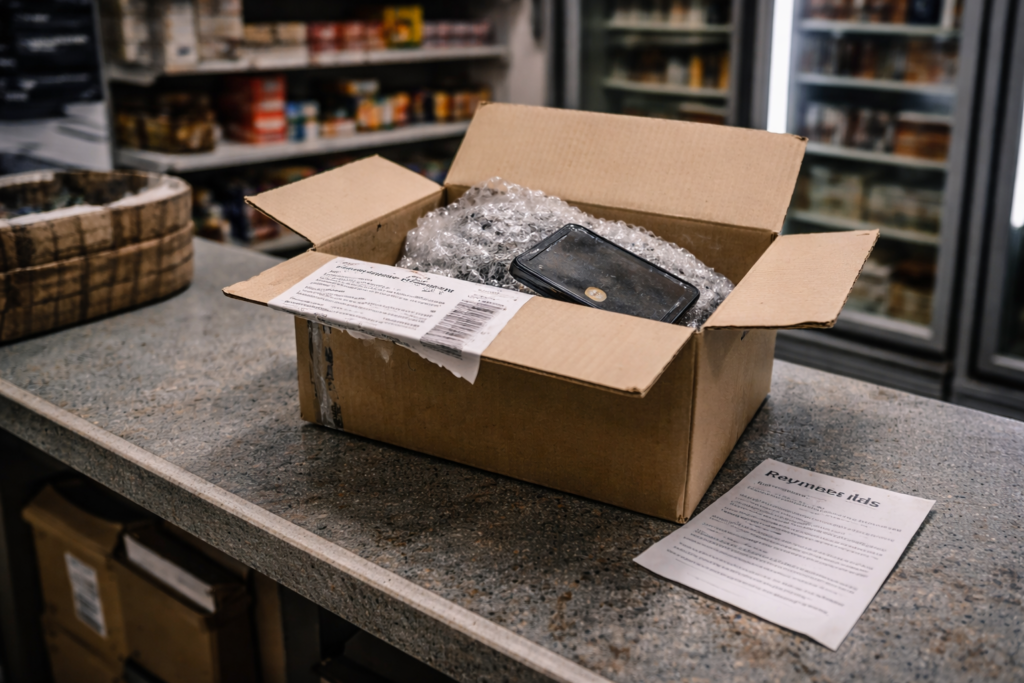
A faulty product return being refused usually starts the same way in UK households: the item stops working or arrives with a defect, the retailer is contacted, and the reply is a flat “no” or a push towards the manufacturer. Common examples include a kettle that trips the electrics, headphones with one dead side, a vacuum that loses suction within weeks, or a phone accessory that never charges properly.
Typical refusal patterns include being told the item is “outside the return window”, that the packaging is missing, that it must be “unused”, or that the fault is “wear and tear”. Another common outcome is being offered store credit only, or being asked to pay return postage for something that is clearly faulty. With online orders, some retailers also insist the customer must deal with the courier damage claim, even though the contract is with the retailer.
In many cases the problem is not the law, but the process: the retailer treats a fault like a change-of-mind return, or staff follow a script that does not match consumer rights. The result is delay, repeated explanations, and pressure to accept a partial solution.
Common reasons for refusal
Mix up return types
The most frequent cause is the retailer applying their “returns policy” (often for unwanted items) to a faulty-goods complaint. Faulty goods are handled differently from “changed mind” returns, and the remedy depends on how long it has been since delivery.
Dispute the fault
Retailers often argue the issue is not a fault: “no fault found”, “user damage”, “water ingress”, “blocked filter”, “incorrect installation”. This is especially common with small appliances, white goods, and electronics where faults can be intermittent.
Push to manufacturer
Another common reason is being redirected to the manufacturer warranty. A warranty can be useful, but it does not replace the retailer’s responsibilities. In practice, this push happens most with marketplace sellers, high-street chains with service desks, and online-only retailers using third-party repair partners.
Missing evidence
Refusals are more likely when there is no proof of purchase, no clear record of the fault, or the item cannot be demonstrated easily. For intermittent faults, a short video often makes the difference.
Delay tactics
Some cases drag because the retailer keeps asking for the same details, offers repair after long waits, or says the inspection will take weeks. The longer it runs, the more likely the retailer tries to reframe the issue as “out of time”.
Fix it step by step
Check dates and method
Find the order date, delivery date, and how it was bought (online, in-store, marketplace). Save the receipt, order confirmation, and payment record. For online orders, keep the delivery confirmation and any courier notes.
Write a fault timeline
Note when the fault first appeared, what happens, and how often. Keep it factual: “fails to power on”, “cuts out after 3 minutes”, “leaks from base”, “screen flickers when charging”. If it is intermittent, record the conditions (battery level, heat, specific setting).
Gather quick proof
Take clear photos of the product, serial number, and any visible defect. Film a 10–30 second video showing the fault (for example, the item not powering on, error code, unusual noise). Keep packaging if available, but do not assume missing packaging removes rights.
Ask for the right remedy
Contact the retailer (not only the manufacturer) and state that the item is faulty. Ask for the remedy that fits the situation: repair, replacement, or refund depending on the circumstances and how long it has been since delivery. If the retailer offers only store credit, ask them to confirm in writing why a refund is being refused.
Use one clear message
Send a single, structured message by email or webform so it is logged. Include: order number, date received, fault description, evidence attached, and the remedy requested. Ask for a response within a reasonable time (for many retailers, 7–14 days is typical for a substantive reply).
Handle “inspection” properly
If the retailer wants to inspect the item, ask what the inspection checks, how long it will take, and what happens if the fault is confirmed. Keep proof of return: tracked postage receipt, collection confirmation, and photos of the item condition before sending. If a courier collects, photograph the parcel and label.
Challenge “no fault found”
If the item comes back marked “no fault found”, ask for the test report: what was tested, for how long, and under what conditions. Provide the video evidence again and ask for a second assessment or an alternative remedy. For intermittent faults, request that the product is tested under the conditions that trigger it (for example, under load, at temperature, connected to a specific accessory).
Escalate within the retailer
When front-line support repeats policy wording, ask for escalation to a supervisor or the complaints team. Keep the request narrow: confirm whether the retailer accepts the goods are faulty; if not, ask for the evidence they rely on. If the retailer is a marketplace seller, also raise it through the platform’s resolution process and keep screenshots.
Use payment protections
If the retailer remains unresponsive or refuses a reasonable remedy, consider the payment route. For credit card purchases, a Section 75 claim may apply in some cases; for debit card or card payments generally, a chargeback may be possible depending on the bank and timing. Provide the timeline, evidence, and the retailer’s refusal in writing.
Keep returns costs clear
If the retailer insists the customer must pay return postage for a faulty item, ask them to confirm this in writing and explain why. In many UK cases, retailers arrange collection or reimburse reasonable return costs when a fault is accepted, but the practical outcome depends on the retailer’s process and whether the fault is disputed.
If it gets ignored
Deadlines become arguments
When a fault is left unresolved, the retailer often shifts the discussion to time limits and “policy windows”. Even where rights still apply, the conversation becomes harder because evidence goes stale and the retailer can claim the issue was not reported promptly.
Costs start stacking
Households often end up paying for return postage, replacement parts, or third-party repairs just to keep things working. With larger items, missed collections and repeat engineer visits can add time off work and extra delivery fees.
Faults can worsen
Small faults can turn into bigger failures: overheating chargers, leaking appliances, or battery issues. If there is any safety concern (burning smell, swelling battery, tripping electrics), stop using the item and report it as a safety fault.
Escalate with strong evidence
Build a simple pack
A strong complaint pack usually includes: proof of purchase, delivery date, fault timeline, photos/video, copies of messages, and proof of return/collection. Keep filenames clear (for example, “Video-fault-12Nov.mp4”).
Ask for written reasons
Request the refusal reason in writing, including whether the retailer says the item is not faulty, is damaged, or is outside time. Written reasons prevent the story changing later and help with card claims or formal complaints.
Use the right channel
Retailers often respond faster to a formal complaint email than to live chat. If there is a published complaints procedure, follow it and keep a copy of the submission confirmation.
Compare similar disputes
If the refusal is part of a wider pattern (store credit only, “policy says no refunds”, repeated delays), it can help to look at how other consumer disputes are handled. For related situations where a business refuses to put things right, see Refund refused by company for practical escalation steps and evidence tips.
FAQ
Can a retailer refuse a return…
Missing packaging is commonly used as a barrier, but it does not automatically remove rights for faulty goods. The key issue is the fault and proof of purchase; packaging can help, but it is not usually the deciding factor.
Is a repair the only option?
Many retailers offer repair first, especially after the earliest period, but the appropriate remedy depends on the situation, the nature of the fault, and what is reasonable. If a repair fails or takes too long, escalation is often justified.
What if the retailer says it…
Ask what evidence supports that conclusion and request the inspection notes. Provide photos and a timeline showing normal use. “Wear and tear” is frequently used where the fault is hard to reproduce.
Should the manufacturer be contacted instead?
Manufacturer support can be quicker, but it is optional. If the retailer refuses to engage, keep the retailer complaint running in parallel so there is a clear record of refusal or delay.
What if the item was bought…
Raise it with the seller and through the marketplace resolution system. Keep screenshots of listings and messages, as listings can change. If payment was by card, payment protection routes may still be available.
How long should an inspection take?
Times vary, but long, open-ended inspections often lead to delay disputes. Ask for a target date and what happens if the deadline is missed.
Before you move on
Collect three things now: proof of purchase, a short video of the fault, and a single written timeline, then send one clear request to the retailer for the remedy wanted and a written reason if they refuse.
If there was pressure to accept store credit or “today only” terms, that often signals the process is being steered away from a proper remedy.
Get help with the next step
If the retailer is still refusing, a short review of the evidence pack and the wording of the complaint can make the next contact more effective. Use the contact form at https://ukfixguide.com/contact/ to share the key dates, refusal wording, and any inspection report.